Location, location, location.
It is one of the most repeated principles in real estate.
And for commercial property, location is undoubtedly important.
But in a competitive market like Gurgaon, location alone may not be enough.
As the city's commercial real estate market becomes more sophisticated, businesses, customers and investors are looking beyond the address.
They are asking:
- Is the property easy to access?
- Is parking convenient?
- Is the design efficient?
- Does it provide a good experience?
- Can businesses operate comfortably?
- Is the building future-ready?
- Will customers want to visit?
- Can the property remain relevant several years from now?
These questions are increasingly important as Gurgaon develops from a traditional office market into a diverse commercial ecosystem combining offices, retail, restaurants, hospitality, lifestyle destinations and mixed-use developments.
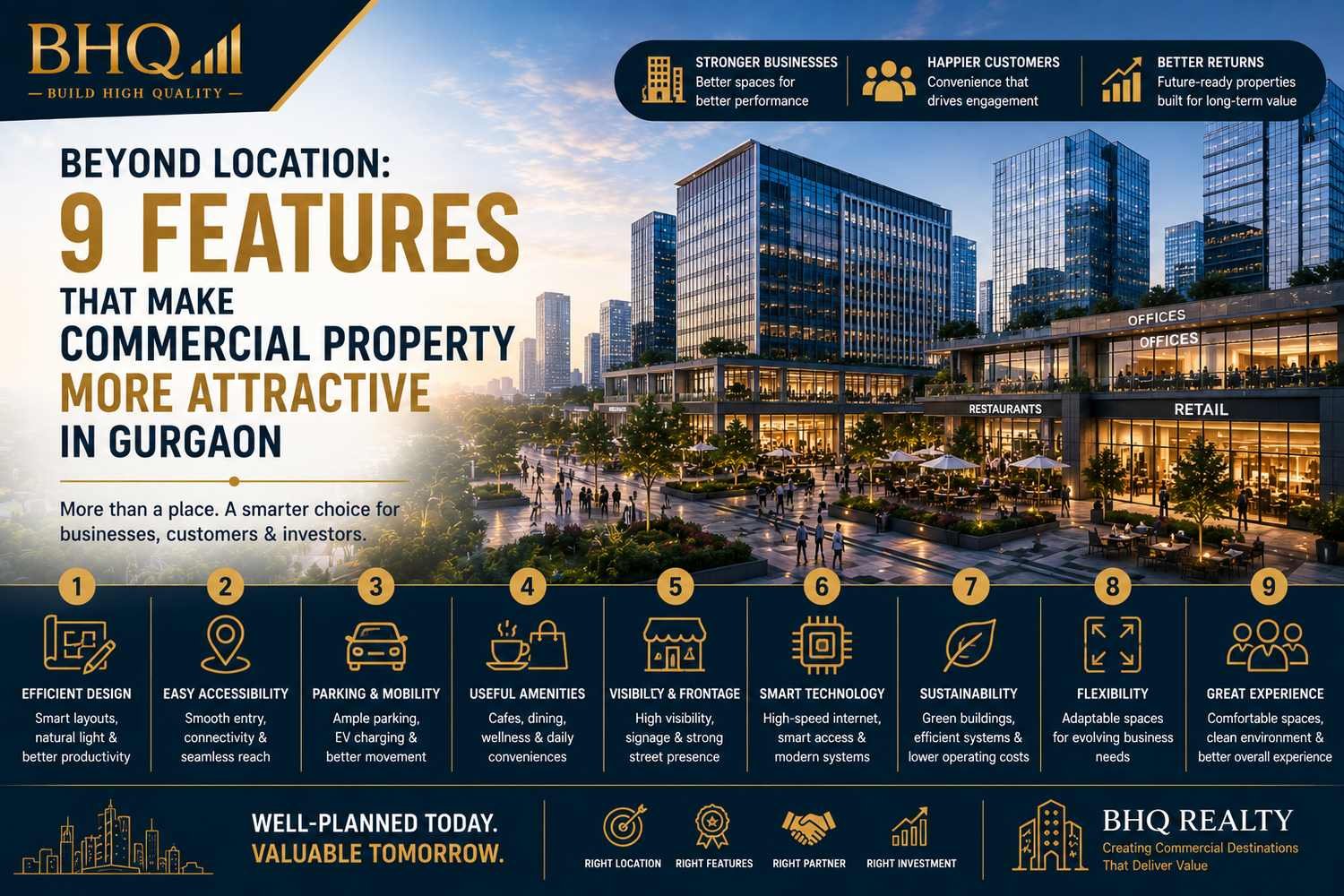
For anyone evaluating commercial property in Gurgaon, here are nine features that can influence the attractiveness and long-term usability of a project.
1. Efficient and Thoughtful Design
The first impression of a commercial property often comes from its design.
But good commercial design is about much more than appearance.
A visually attractive building needs to function well.
Businesses need efficient floor plans.
Retailers need visibility.
Restaurants need appropriate access.
Customers need intuitive movement.
Employees need comfortable workspaces.
A well-designed commercial property should consider how different users interact with the building.
Important design considerations include:
- Efficient floor layouts
- Natural light
- Appropriate ceiling heights
- Clear circulation
- Well-planned entrances
- Visibility
- Flexible spaces
- Comfortable common areas
The goal should be simple:
Make the space easy to understand, easy to use and easy to adapt.
2. Accessibility That Works in the Real World
A property can be located near a major road and still be inconvenient to access.
This is why investors should evaluate actual accessibility, rather than simply looking at a map.
Consider:
- Entry and exit points
- Approach roads
- Traffic conditions
- Turning movements
- Public transportation
- Pedestrian access
- Drop-off areas
- Service access
For a commercial project, accessibility affects almost everyone:
- Employees.
- Customers.
- Clients.
- Suppliers.
- Delivery teams.
- Visitors.
A few minutes of additional travel or a difficult entrance can significantly affect the user experience.
3. Parking and Mobility
Parking remains one of the most important practical considerations for commercial property in Gurgaon.
A customer may be interested in visiting a restaurant or showroom but become frustrated if parking is difficult.
Similarly, employees and office visitors need predictable parking arrangements.
A well-planned commercial development should consider:
- Visitor parking
- Dedicated parking
- Entry and exit
- Traffic circulation
- Two-wheeler parking
- Drop-off zones
- EV charging
- Accessible parking
But mobility is becoming broader than cars.
Modern developments may also need to consider:
- Ride-sharing
- Public transport
- Pedestrian movement
- Cycling
- Electric vehicles
- Delivery vehicles
The future commercial destination needs to think about how people arrive, not just where vehicles are parked.
4. A Strong Mix of Amenities
Amenities can play an important role in making commercial spaces more useful.
But the best amenities are not necessarily the ones with the longest brochure.
The right question is:
Which amenities actually improve the experience of the people using the property?
For an office-oriented development, useful amenities may include:
- Cafés
- Restaurants
- Meeting areas
- Business lounges
- Fitness facilities
- Wellness spaces
- Convenience retail
For a retail-oriented development, useful features may include:
- Dining
- Outdoor seating
- Family areas
- Entertainment
- Events
- Comfortable public spaces
Amenities should support the project's intended users.
5. Visibility and Frontage for Retail
For customer-facing businesses, visibility can be critical.
A retail property should ideally allow businesses to be easily identified.
Important factors can include:
- Road frontage
- Storefront visibility
- Signage opportunities
- Corner positioning
- Pedestrian visibility
- Entrance placement
- Internal wayfinding
A customer should not have to work hard to find a business.
This is particularly important for:
- Restaurants
- Cafés
- Showrooms
- Salons
- Lifestyle brands
- Convenience retail
However, visibility should be considered alongside customer catchment.
A highly visible property in a weak catchment may still struggle.
6. Technology and Smart Building Features
Commercial buildings are becoming increasingly technology-driven.
Businesses today depend heavily on digital infrastructure.
A modern commercial property may need to support:
- High-speed internet
- Reliable connectivity
- Digital access control
- Smart security
- Building management systems
- Digital visitor management
- Smart parking
- Energy monitoring
Technology can also improve the day-to-day experience.
For example, a building management system can help monitor energy consumption.
Digital access can reduce friction at entrances.
Smart parking systems can make vehicle movement more efficient.
The important principle is that technology should solve real problems.
7. Sustainability and Efficient Operations
Sustainability is becoming increasingly relevant in commercial real estate.
For businesses, a building's environmental performance can be connected to corporate sustainability goals.
For property owners, efficient systems can potentially help manage operating costs.
Potential features include:
- Energy-efficient lighting
- Efficient HVAC systems
- Water conservation
- Waste management
- Renewable energy integration
- Green landscaping
- EV charging
- Natural lighting
- Sustainable materials
Sustainability should therefore be viewed as both an environmental and long-term operational consideration.
8. Flexibility for Changing Business Needs
One of the biggest challenges in commercial real estate is predicting what businesses will need several years from now.
Business models change.
Companies grow.
Teams shrink.
Workplace strategies evolve.
Technology changes.
A commercial property designed only for one specific use can become less flexible over time.
This is why adaptable design can be valuable.
A flexible commercial space may allow:
- Different office layouts
- Expansion
- Reconfiguration
- Multiple business formats
- Collaborative areas
- Private workspaces
- Retail adaptation
Flexibility can help a property remain useful as tenant requirements change.
9. Experience and the Overall Environment
Perhaps the biggest shift in commercial real estate is the move from space to experience.
People spend a significant part of their day in commercial environments.
They increasingly notice:
- Landscaping
- Lighting
- Cleanliness
- Seating
- Noise
- Walkability
- Food options
- Common areas
- Security
- Overall ambience
A commercial property that feels comfortable and welcoming can potentially create a stronger connection with users.
This is particularly important for mixed-use destinations.
A person may visit for one reason and stay because the environment gives them additional reasons to spend time there.
Why These Features Matter More in Gurgaon
Gurgaon's commercial market has become increasingly competitive.
The city now has:
- Large corporate campuses
- Premium office buildings
- High-street retail
- Shopping malls
- Mixed-use developments
- Restaurants
- Hospitality
- Flexible offices
- Neighbourhood commercial destinations
As options increase, businesses and customers have more choices.
That means commercial projects need to differentiate themselves.
The difference may no longer be simply:
"We have a good location."
Instead, it may be:
"We have a good location and provide a better overall experience."
The Importance of the Surrounding Ecosystem
A commercial property doesn't operate in isolation.
The surrounding environment can be just as important as the building itself.
Consider a commercial development surrounded by:
- Residential communities
- Corporate offices
- Hotels
- Restaurants
- Schools
- Healthcare
- Retail
- Public transportation
This creates a broader ecosystem.
Different users can support one another.
Office employees become customers.
Residents become customers.
Visitors become customers.
Businesses serve one another.
This is one of the reasons mixed-use and integrated commercial developments are becoming increasingly relevant.
Office Property Needs a Different Set of Features
Office Property Needs a Different Set of Features
A commercial office project should focus on the needs of modern businesses.
Important features may include:
- Efficient floor plates: Businesses need space that can be configured effectively.
- Reliable connectivity: Digital infrastructure is essential.
- Employee amenities: Food, wellness and convenience services can improve workplace experience.
- Meeting facilities: Modern companies need spaces for collaboration.
- Parking: Employees and visitors need convenient access.
- Security: Businesses require secure working environments.
- Flexibility: Companies need the ability to adapt their workplace.
Retail Property Needs a Different Approach
Retail properties depend heavily on customers.
Therefore, features such as these can become important:
- Visibility: Customers need to see the business.
- Accessibility: Customers should be able to reach the property easily.
- Parking: Convenience influences visits.
- Footfall: Relevant customer movement matters.
- Tenant mix: Complementary businesses can strengthen the destination.
- Experience: Customers need reasons to visit physical retail spaces.
- Signage: Clear identification can improve discoverability.
The same building feature does not have equal value for every commercial use.
What Makes a Property "Future-Ready"?
A future-ready commercial property does not mean a building filled with expensive technology.
It means a property that can adapt.
A future-ready project should ideally consider:
- Changing businesses
- Changing technology
- Changing consumer behaviour
- Changing mobility
- Changing sustainability requirements
- Changing workplace expectations
This requires thoughtful planning from the beginning.
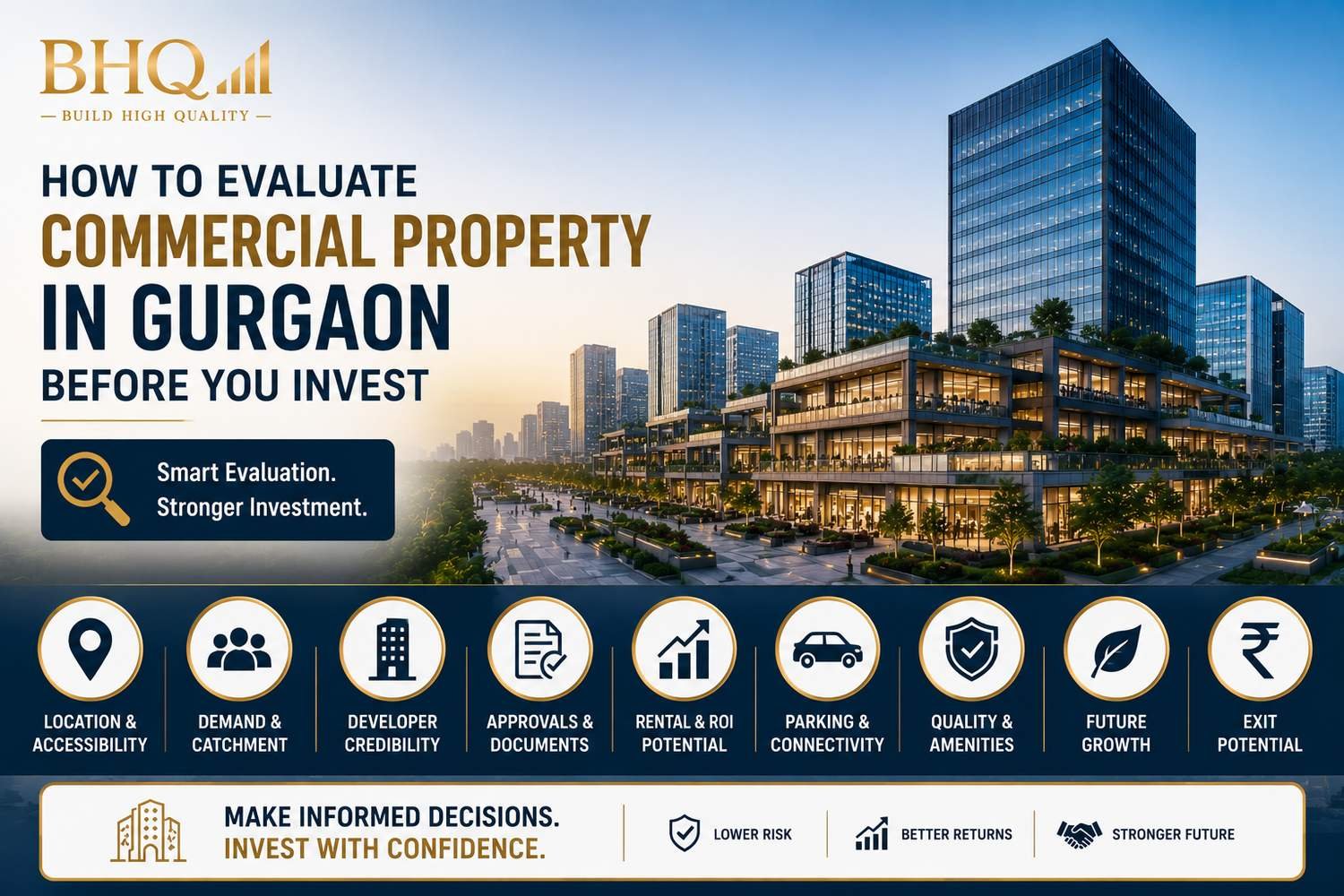
A Practical Checklist for Buyers
If you are evaluating commercial property in Gurgaon, consider asking:
- Location: Is the micro-location suitable for the intended use?
- Connectivity: Can employees and customers reach it easily?
- Parking: Is parking sufficient and well managed?
- Design: Are the spaces efficient and adaptable?
- Visibility: Will customers easily find the property?
- Amenities: Do the amenities serve actual users?
- Technology: Is the building digitally ready?
- Sustainability: Are efficient systems incorporated?
- Tenant Mix: Will complementary businesses create a strong ecosystem?
- Management: Who will operate and maintain the property?
- Future: Can the property remain relevant as the market changes?
What Investors Should Avoid
Not every attractive-looking feature adds genuine commercial value.
Investors should be careful about:
Overemphasis on luxury
Premium finishes are useful only when they support the intended market.
Too many unnecessary amenities
More amenities do not automatically mean better commercial performance.
Future promises without verification
Infrastructure and projected demand should be independently assessed.
Ignoring operating costs
A property can look attractive while carrying significant maintenance expenses.
Focusing only on price
The lowest price is not necessarily the best commercial opportunity.
Ignoring competition
New supply can change the commercial landscape.
BHQ Realty's Approach
BHQ Realty is building its presence in Gurgaon through real estate development and commercial property services, including private developments, builder floors, commercial property consulting and investor deal structuring. BHQ Realty
As BHQ Realty prepares to introduce its first commercial project in Gurgaon, these principles provide an important framework for modern commercial development.
The objective is not simply to create a building.
It is to create a commercial environment where:
- Businesses can operate efficiently.
- Employees can work comfortably.
- Customers can visit conveniently.
- Retailers can build their brands.
- Investors can evaluate long-term relevance.
That requires attention to every layer of the experience from the approach road to the entrance, from the parking area to the workspace, and from the building design to the surrounding ecosystem.
The Commercial Property of Tomorrow Will Be More Than Space
The next generation of commercial real estate in Gurgaon is likely to be judged by more than square footage.
It will be judged by:
- How easy is it to reach?
- How efficiently can businesses operate?
- How comfortable is the environment?
- How flexible is the space?
- How sustainable is the building?
- How good is the customer experience?
- How well does the project fit into its surroundings?
These questions reflect a broader shift in real estate.
The market is moving from:
Property → Experience
and from:
Space → Ecosystem
Conclusion
Location will always remain fundamental to commercial real estate.
But in a competitive market like Gurgaon, the best commercial opportunities are likely to be influenced by much more than location alone.
Thoughtful design, accessibility, parking, amenities, technology, sustainability, flexibility, visibility and overall experience can all contribute to the attractiveness of a commercial destination.
For businesses, these features can make daily operations easier.
For customers, they can make visits more convenient.
For developers, they create opportunities for differentiation.
For investors, they can provide another layer of information when evaluating the long-term relevance of a property.
As Gurgaon continues to evolve into a sophisticated business and lifestyle destination, commercial real estate will need to evolve with it.
For BHQ Realty, that means looking beyond simply building commercial space.
It means creating well-planned, future-ready destinations designed around the people and businesses that will use them.
Because great commercial real estate isn't just about where you build.
It's about what you build around the people who use it.
Frequently Asked Questions
What makes commercial property attractive in Gurgaon?
Location, connectivity, parking, design, visibility, amenities, technology, sustainability, flexibility, tenant mix and surrounding development can all influence the attractiveness of a commercial property.
Are amenities important for commercial property?
Yes, when they serve the needs of the intended users. Useful amenities can improve convenience and experience, but more amenities do not automatically mean better commercial performance.
Why is parking important in Gurgaon commercial property?
Convenient parking can influence employee, customer and visitor experience, particularly for retail, restaurants and other customer-facing businesses.
What is future-ready commercial real estate?
Future-ready commercial real estate is designed to remain useful as technology, business models, workplace requirements, mobility and consumer behaviour change.
Should investors focus only on location?
No. Location is fundamental, but investors should also evaluate accessibility, demand, design, competition, costs, developer quality, management and long-term relevance.
What is BHQ Realty?
BHQ Realty is a Gurgaon-focused real estate company involved in development and commercial property services and is preparing to bring its first commercial project to Gurgaon.