
Commercial real estate can be an attractive part of a property portfolio.
But buying a commercial property is fundamentally different from buying a home.
With residential property, the decision is often driven by factors such as location, lifestyle, floor plan, amenities and personal requirements.
Commercial property requires another layer of analysis.
You need to understand:
- Who will use the property?
- Why will they use it?
- What businesses can operate there?
- How accessible is the location?
- What competing supply exists?
- What are the total costs?
- What happens if the property remains vacant?
- Who will buy it from you in the future?
These questions become particularly important in a large and rapidly developing market such as Gurgaon.
The city has a diverse commercial ecosystem comprising offices, retail destinations, restaurants, mixed-use developments, high-street properties and business centres.
That creates opportunity but also means buyers have more options to compare.
So before investing in commercial property in Gurgaon, what should you actually evaluate?
Let's break it down.
1. Start With the Purpose of the Property
Before looking at price, understand the property's intended purpose.
Is it primarily designed for:
- Office use?
- Retail?
- Restaurant?
- Showroom?
- Professional services?
- Mixed-use activity?
- Investment and leasing?
Different commercial formats have different demand drivers.
For example:
- An office property depends heavily on businesses and employees.
- A retail property depends more heavily on customers, visibility and catchment.
- A restaurant requires customer accessibility, parking and operational suitability.
Therefore, the first question should be:
What type of commercial activity is this property designed to support?
A property becomes easier to evaluate once its intended use is clear.
2. Study the Micro-Market, Not Just Gurgaon
"Gurgaon" is a huge real estate market.
Different sectors and corridors have completely different characteristics.
An established corporate district is not the same as an emerging development corridor.
A residential-led market is different from a retail destination.
A premium office corridor is different from a neighbourhood commercial cluster.
Therefore, move through the following levels:
- Gurgaon
- Corridor
- Sector
- Micro-location
- Property
This approach helps you understand the actual market around the asset.
3. Understand Who Creates Demand
One of the most important questions in commercial real estate is:
Who is the customer?
For an office: Employees + Companies + Clients
For retail: Residents + Employees + Visitors
For restaurants: Customers + Nearby Offices + Residents
For neighbourhood services: Local Residents
The stronger the relationship between the property and its target users, the easier it becomes to understand its commercial potential.
Don't simply ask:
"Is there footfall?"
Ask:
"Is there relevant footfall?"
A premium retailer may prefer fewer high-value customers over a large number of irrelevant visitors.
4. Evaluate Current Demand
Don't rely entirely on future projections.
Look at what is happening today.
Check:
- Existing businesses
- Occupancy
- Nearby offices
- Residential population
- Retail activity
- Restaurants
- Customer movement
- Rental activity
- New business registrations
- Nearby developments
A location where businesses are already operating successfully can provide useful evidence of commercial demand.
This doesn't guarantee future performance but it gives you something more tangible than a projection.
5. Analyse Upcoming Supply
Strong demand can attract developers.
That can be positive.
But too much new supply can increase competition.
Before buying, identify:
- Existing commercial projects
- Under-construction developments
- Upcoming launches
- Vacant inventory
- Competing retail destinations
- New office supply
Ask:
How much commercial space will compete with this property over the next few years?
This is particularly important for investors looking at rental income.
6. Location Is More Than a Pin on Google Maps
A property's location should be evaluated from the perspective of the actual user.
Consider:
Road connectivity
How easily can vehicles reach the property?
Public transportation
Can employees and customers reach it without private vehicles?
Visibility
Can people see the property from the main approach?
Parking
Is there convenient parking?
Entry and exit
Are the access points practical?
Surrounding development
What exists around the property?
Future connectivity
Are there verified infrastructure improvements that may affect accessibility?
A location can look excellent on a map and still have practical accessibility problems.
A physical site visit is therefore essential.
7. Visit the Property at Different Times
This is one of the simplest but most useful due-diligence steps.
Visit:
Morning
Afternoon
Evening
Weekend
Why?
Because commercial activity changes throughout the day.
You may discover:
- Traffic congestion
- Parking shortages
- Different footfall patterns
- Noise levels
- Limited evening activity
- Strong weekend demand
- Difficult access during peak hours
A property should be evaluated based on its real operating environment, not just its brochure.
8. Check the Developer's Track Record
The developer matters.
A well-located project can still face problems if execution is weak.
Before investing, research:
- Previous developments
- Delivery history
- Construction quality
- Customer feedback
- Maintenance
- Project execution
- Transparency
- Reputation
For a new or emerging developer, buyers should conduct even more detailed due diligence.
Ask:
Does the developer have the capability to deliver what is being promised?
9. Verify Project Approvals and Documentation
Commercial property involves significant financial commitments.
Documentation should therefore be carefully verified.
Depending on the project and property type, buyers may need to examine:
- Project registration
- Land title
- Development permissions
- Building approvals
- Fire-related approvals
- Occupancy/completion documentation where applicable
- Commercial-use permissions
- Sale agreement
- Payment schedule
- Maintenance obligations
Do not rely solely on verbal assurances.
Important documents should be independently reviewed by qualified legal and financial professionals where appropriate.
10. Understand Exactly What You Are Buying
Commercial property terminology can sometimes be confusing.
A buyer should clearly understand:
- Carpet area
- Built-up area
- Super area
- Common areas
- Exclusive areas
- Parking rights
- Signage rights
- Access rights
- Maintenance responsibilities
Don't compare two properties simply based on their quoted price.
Compare:
Usable area + total acquisition cost + location + facilities + commercial potential.
The cheapest quoted square-foot price does not necessarily represent the best value.
11. Calculate the Total Acquisition Cost
The purchase price is only one component.
Depending on the transaction, additional costs may include:
- Registration
- Stamp duty
- Taxes
- Maintenance deposits
- Parking charges
- Brokerage
- Legal fees
- Interior fit-out
- Financing costs
- Other applicable charges
This means investors should calculate:
Total Cost of Acquisition
rather than simply looking at the advertised property price.
This provides a much clearer picture of the investment.
12. Don't Look at Rental Yield in Isolation
Rental yield is an important metric for commercial investors.
But it should not be the only metric.
For example, a property might advertise an attractive rental return.
But ask:
- Is the rent realistic?
- Who is the tenant?
- Is the tenant already operating?
- How long is the lease?
- What happens after lease expiry?
- Who pays maintenance?
- What is the vacancy risk?
- Are there rent escalations?
- What is the current market rent?
A projected rental number is not the same thing as a guaranteed income.
13. Understand the Tenant Profile
If the property is already leased, examine the tenant carefully.
A tenant can influence the quality of a commercial investment.
Important questions include:
- Who is the tenant?
- What business do they operate?
- How long is the lease?
- What are the renewal terms?
- Who is responsible for maintenance?
- Are there escalation clauses?
- What happens if the tenant leaves?
A strong tenant can provide stability.
But investors should still evaluate the underlying property independently.
14. Evaluate Vacancy Risk
Every commercial property faces some degree of vacancy risk.
The question is:
How easy will it be to find the next tenant?
A property serving a broad range of businesses may have a larger potential tenant pool.
A highly specialised property may have fewer potential users.
Consider:
- Location
- Property size
- Layout
- Accessibility
- Visibility
- Parking
- Rental expectations
- Competing properties
The broader the suitable tenant base, the more flexible the asset may be.
15. Study the Surrounding Residential Catchment
For many commercial properties, nearby residential development is a major demand driver.
Residents need:
- Restaurants
- Cafés
- Grocery
- Healthcare
- Fitness
- Salons
- Education
- Professional services
A growing residential catchment can therefore create opportunities for neighbourhood commercial property.
But don't only count the number of residential projects.
Ask:
Are people actually living there?
There is a major difference between:
Units launched
and
Population actually present.
16. Study the Office Catchment Too
The reverse is also true.
Office employees create demand for:
- Food
- Coffee
- Convenience
- Retail
- Fitness
- Services
A commercial project located between large residential and office populations can potentially benefit from both.
This is one reason mixed-use ecosystems can be powerful.
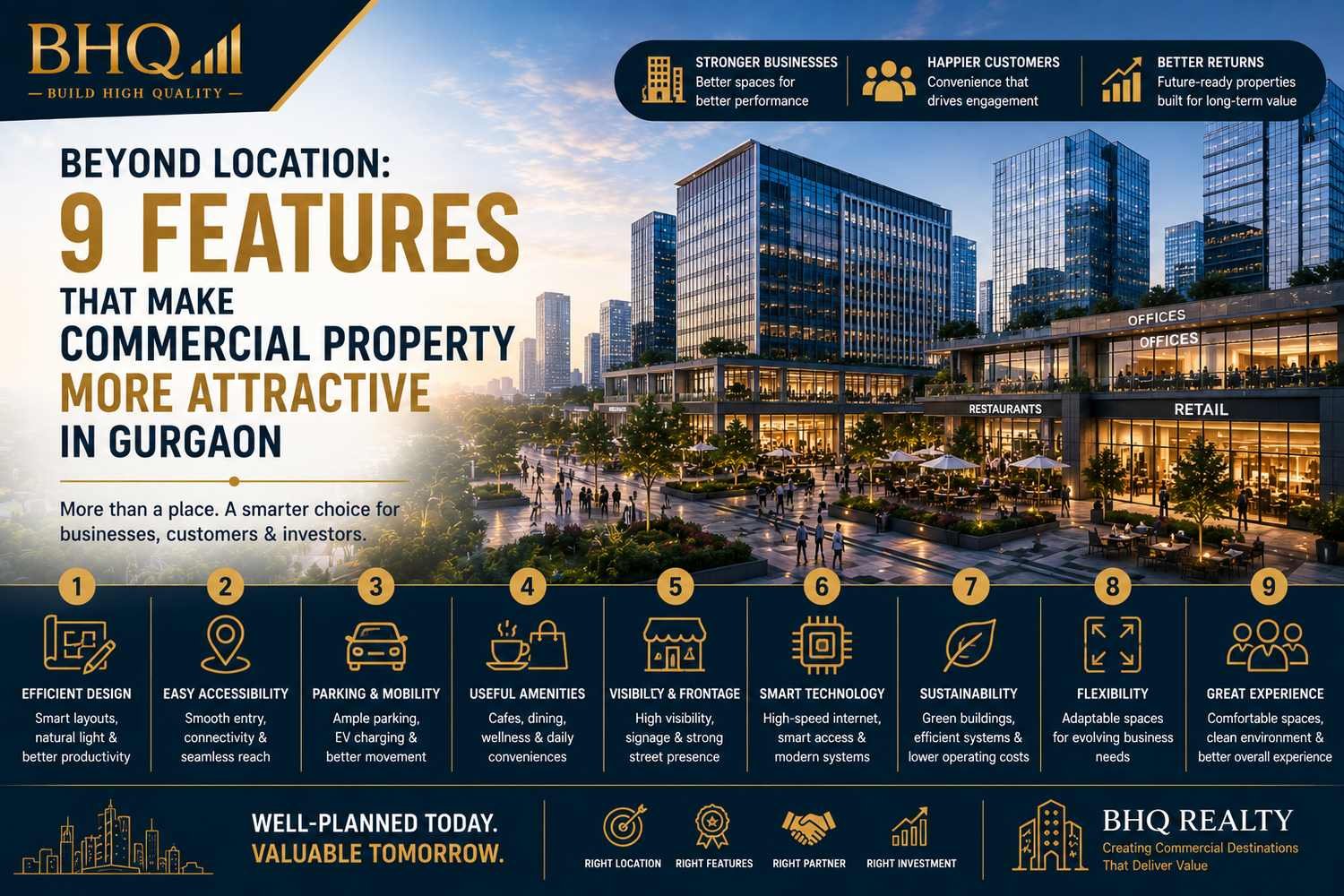
17. Examine Parking Carefully
Parking deserves its own section because it can have a direct impact on customer experience.
Ask:
- How many parking spaces are available?
- Is visitor parking available?
- Is parking dedicated or shared?
- How easy is entry and exit?
- Is there two-wheeler parking?
- Is EV charging planned or available?
- What happens during peak hours?
A restaurant or retail destination can lose customers if parking becomes a repeated problem.
18. Evaluate the Building's Design
Commercial buildings need to work operationally.
Look at:
Floor plate efficiency
How much usable space does the layout provide?
Natural light
Does the space feel comfortable?
Ceiling height
Is it appropriate for the intended use?
Circulation
Can people move efficiently?
Elevators
Are there sufficient vertical-transport facilities?
Service access
Can deliveries and maintenance happen without disrupting customers?
Emergency systems
Are relevant safety provisions in place?
The best commercial properties combine aesthetics with functionality.
19. Consider Future Flexibility
Businesses change.
A tenant may expand.
Another may need fewer employees.
A retail format may evolve.
Technology may change how offices operate.
Therefore, flexible properties can have an advantage.
Look for spaces that can potentially accommodate:
- Different layouts
- Multiple business types
- Reconfiguration
- Expansion
- Modern workplace requirements
A property should ideally remain useful as market requirements evolve.
20. Evaluate Technology Infrastructure
Modern businesses depend heavily on technology.
Commercial property buyers should consider:
- Internet connectivity
- Backup systems
- Access control
- CCTV
- Digital visitor management
- Smart building systems
- Building management systems
- Parking technology
Technology is becoming part of the basic infrastructure of modern commercial property.
21. Sustainability Can Influence Long-Term Value
Sustainable commercial buildings can potentially offer benefits in terms of:
- Energy efficiency
- Water management
- Operating costs
- Employee comfort
- Corporate ESG requirements
Look for features such as:
- Efficient lighting
- Efficient HVAC
- Water conservation
- Waste management
- Green landscaping
- Renewable energy
- EV infrastructure
Sustainability should be evaluated as part of the property's overall operating strategy.
22. Study the Tenant Mix
If you're buying into a retail or mixed-use development, examine the surrounding businesses.
A good tenant mix can create a commercial ecosystem.
For example:
Café + Restaurant + Salon + Fitness + Retail
may serve a broader catchment than:
Five businesses offering essentially the same service.
Complementary businesses can potentially create cross-visitation.
This is why tenant planning matters.
23. Compare the Property With Alternatives
Never evaluate a property in isolation.
Create a shortlist of comparable projects.
Compare:
· Location |
· Price |
· Usable Area |
· Parking |
· Accessibility |
· Tenant Demand |
· Developer |
· Supply |
· Amenities |
· Rental Potential |
· Exit Potential |
A comparison often reveals differences that are difficult to notice when evaluating one project at a time.
24. Think About the Exit Before You Enter
A surprisingly important question is:
Who will buy this property from me?
Don't only think about the current purchase.
Think five or ten years ahead.
Potential future buyers may include:
- Investors
- Business owners
- Companies
- Retailers
- HNIs
- Other property investors
The broader the potential buyer pool, the more flexible the asset may be.
This is why location, usability and demand matter so much.
25. Don't Depend Entirely on Future Appreciation
Capital appreciation is attractive.
But it should not be the entire investment thesis.
A stronger analysis considers multiple potential value drivers:
- Rental income
- Business demand
- Location
- Infrastructure
- Asset quality
- Supply-demand balance
- Exit liquidity
The more fundamentals supporting a property, the more robust the investment thesis can potentially become.
26. Watch for Red Flags
Before investing, be cautious if you encounter:
Unrealistic returns
Very high guaranteed returns should be examined carefully.
Pressure to book immediately
A genuine investment decision should allow adequate due diligence.
Unverified infrastructure claims
Always check official sources.
Unclear documentation
Do not proceed until documentation is satisfactory.
Excessive supply
A beautiful project can still face commercial challenges if competing inventory is too high.
Unclear maintenance
Understand who manages the property and what it costs.
Overly optimistic rental assumptions
Verify actual market rents.
27. The Best Commercial Property Is Not Always the Most Expensive
Premium pricing does not automatically mean premium investment.
The right property is one where:
Price + Location + Demand + Quality + Usability + Future Potential
make sense together.
A very expensive property in an oversupplied location can be less attractive than a moderately priced property with stronger fundamentals.
This is why comparative analysis matters.
28. What Does This Mean for Gurgaon in 2026?
Gurgaon's commercial market has become increasingly sophisticated.
The city now has:
- Established corporate districts
- Large office ecosystems
- GCC activity
- Retail destinations
- Mixed-use developments
- Residential catchments
- Emerging commercial corridors
This creates opportunities across multiple formats.
But it also means buyers have more choices.
The result?
Due diligence matters more than ever.
Investors need to distinguish between:
Marketing
and
Market fundamentals.
BHQ Realty's Perspective
BHQ Realty is building its presence in Gurgaon through real estate development and commercial property services, including private developments, builder floors, commercial property consulting and investor deal structuring. BHQ Realty
As BHQ Realty prepares to introduce its first commercial project in Gurgaon, understanding the fundamentals of commercial property is central to the development approach.
The objective should not simply be to create inventory.
It should be to create commercial space that responds to:
- Business demand
- Customer behaviour
- Connectivity
- Accessibility
- Quality
- Design
- Technology
- Sustainability
- Long-term usability
For investors, this provides a useful framework for evaluating any commercial opportunity not just a BHQ Realty project.
A 10-Point Checklist Before You Invest
Before making a commercial property decision, ask:
- Is the location right?
- Who creates demand here?
- How accessible is the property?
- What competing supply exists?
- Is the developer credible?
- Are the documents and approvals clear?
- What is the total acquisition cost?
- Is the rental assumption realistic?
- Who could buy or lease the property later?
- Does the investment still make sense without relying on aggressive future appreciation?
If you can answer these questions confidently, you are in a much stronger position to evaluate the opportunity.
Conclusion
Commercial real estate can provide interesting opportunities, but it should never be treated as a simple purchase of square footage.
A commercial property is part of a larger ecosystem.
Its success can depend on:
- Location
- Demand
- Accessibility
- Design
- Parking
- Tenant mix
- Developer quality
- Infrastructure
- Supply
- Business activity
- Management
- Future relevance
This is why due diligence is so important.
The best investment decision is not necessarily the property with the biggest brochure or the most impressive promised return.
It is the property where the fundamentals make sense.
For Gurgaon investors, that means looking beyond the immediate project and understanding the micro-market, the users, the competition and the long-term commercial ecosystem.
As Gurgaon continues to mature, informed decision-making will become increasingly important.
Don't invest only in a property.
Understand the business ecosystem around it.
That is where the real commercial story begins.
Frequently Asked Questions
What should I check before buying commercial property in Gurgaon?
Start with location, demand, accessibility, developer track record, approvals, total cost, rental potential, competing supply, tenant profile and future exit potential.
Is commercial property riskier than residential property?
Commercial property has different risks rather than simply being "more risky." Vacancy, tenant quality, business demand and property-specific factors can be particularly important.
How important is location for commercial property?
Location is fundamental, but it should be assessed alongside accessibility, customer catchment, office population, competition, parking and actual business activity.
How can I calculate commercial property rental yield?
Rental yield is generally calculated by comparing annual rental income with the property's total acquisition cost. Investors should also account for vacancy, maintenance, taxes and other applicable expenses.
Should I buy commercial property based on promised rental returns?
No. Projected or promised returns should be independently evaluated against actual market rents, tenant demand, lease terms and vacancy risk.
Why is tenant mix important?
A complementary tenant mix can increase the reasons customers have to visit a commercial destination and may create cross-business demand.
What is the most important factor when evaluating commercial property?
There is no single factor. A strong investment typically requires a combination of suitable location, genuine demand, accessibility, quality, reasonable pricing, credible development and long-term usability.
What is BHQ Realty?
BHQ Realty is a Gurgaon-focused real estate company involved in development and commercial property services and is preparing to introduce its first commercial project in Gurgaon.