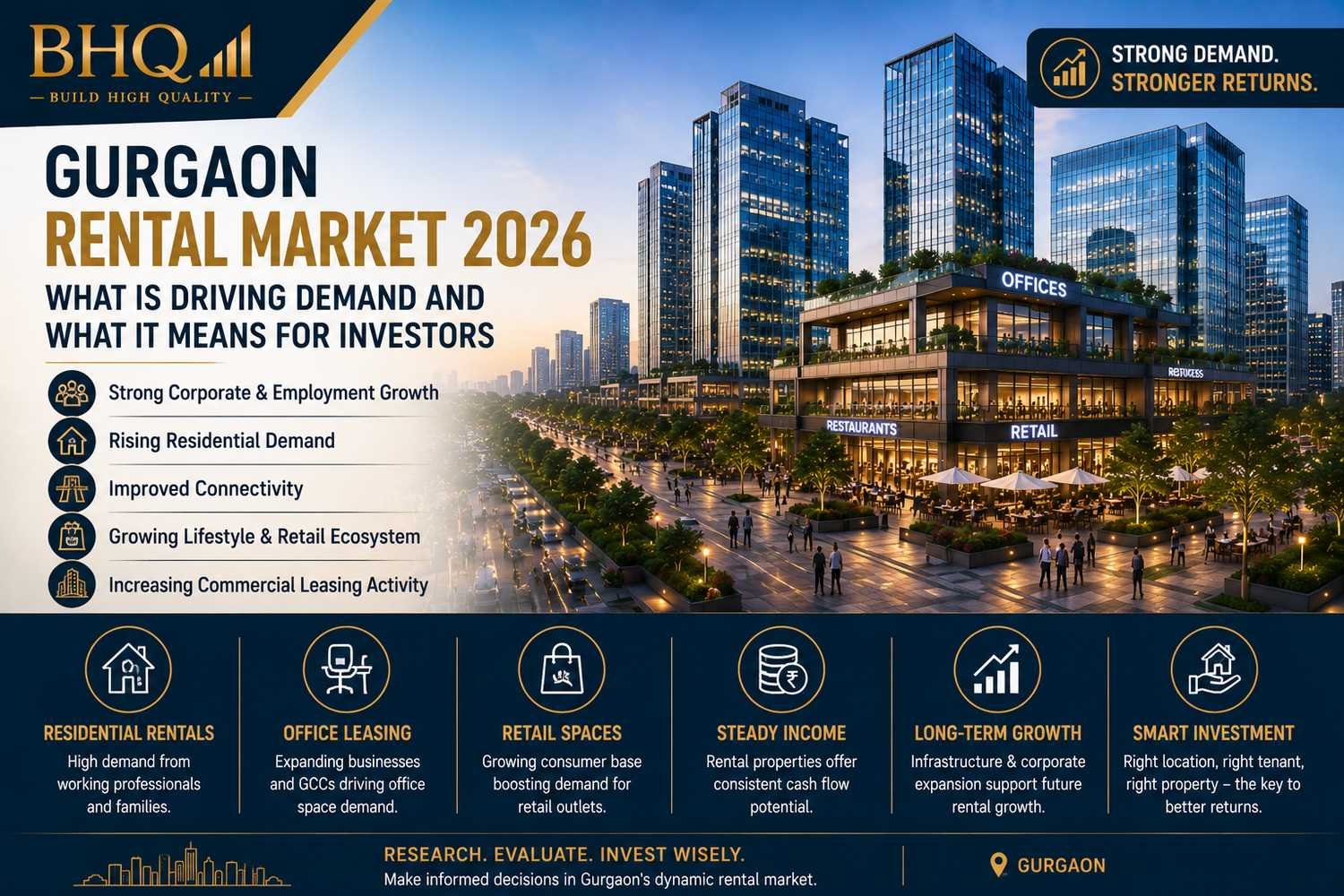
Gurgaon's real estate story is often discussed through the lens of property prices.
But there is another equally important indicator of the city's real estate strength:
Rental demand.
A property can appreciate in value, but rental demand provides another way to understand whether people and businesses actually need space in a particular location.
Gurgaon has a unique rental ecosystem.
Corporate employees rent homes close to their workplaces.
Businesses lease offices.
Startups use flexible workspaces.
Retailers rent commercial units.
Restaurants occupy high-street spaces.
Professionals look for centrally located offices.
This creates demand across multiple segments of the property market.
As Gurgaon's corporate and residential ecosystem continues to expand, understanding the rental market can provide useful insights for both property owners and investors.
Why Rental Demand Matters
Property prices tell us what buyers are willing to pay.
Rent tells us what users are willing to pay to occupy or use a property.
For investors, this distinction is important.
A property with strong rental demand may have:
- A larger tenant pool
- Better occupancy prospects
- More consistent cash-flow potential
- Greater practical utility
- Stronger local demand fundamentals
However, rental income should never be viewed as guaranteed.
Vacancy, maintenance, taxes, tenant turnover and market conditions can all affect actual returns.
1. Gurgaon's Corporate Ecosystem Supports Rental Demand
One of the biggest rental-demand drivers is employment.
Gurgaon has developed into a major corporate destination with offices across sectors including:
- Technology
- Financial services
- Consulting
- Consumer businesses
- Professional services
- Global Capability Centres
- Startups
- Multinational companies
When businesses create jobs, employees need places to live.
This creates a direct connection between:
Employment → Housing demand → Rental demand
The same principle applies to commercial property.
More businesses create demand for office and commercial space.
2. Proximity to Work Still Matters
Even with hybrid work becoming more common, location remains important.
Many professionals still prefer living relatively close to their workplace.
Why?
Because commuting takes time.
A shorter commute can mean:
- Less travel
- Lower transportation costs
- Better work-life balance
- More personal time
This makes residential properties near established employment centres particularly relevant to the rental market.
For landlords, understanding the dominant employment hubs around a property can therefore be useful.
3. Rental Demand Is Not Uniform Across Gurgaon
This is an important point.
Gurgaon is not one single rental market.
Different areas attract different tenant profiles.
For example:
Corporate corridors
Often attract professionals working in nearby offices.
Premium residential areas
May attract senior executives and higher-income tenants.
Emerging sectors
Can attract employees seeking newer housing at different price points.
Areas near transportation corridors
May appeal to tenants who commute across Gurgaon or Delhi-NCR.
Therefore, investors should study the micro-market rather than relying on city-wide rental averages.
4. Tenant Preferences Are Changing
Today's tenants increasingly look beyond basic housing.
Depending on the tenant profile, preferences can include:
- Good connectivity
- Security
- Parking
- Power backup
- Fitness facilities
- Nearby retail
- Restaurants
- Schools
- Healthcare
- Quality construction
- Reliable maintenance
This means rental properties are increasingly competing on overall living experience.
A well-maintained property in a convenient ecosystem can be more attractive than a larger property in an inconvenient location.
5. Furnished and Managed Rentals
Another trend worth watching is the growing importance of convenience.
Some tenants prefer properties that are ready to occupy.
This can include:
- Furnished homes
- Managed apartments
- Housekeeping
- Maintenance support
- Security
- Digital access
- Community facilities
This segment can appeal particularly to:
- Corporate employees
- Professionals relocating to Gurgaon
- Employees on temporary assignments
- People moving from other cities
The exact economics vary, so investors should compare the additional rental income with furnishing and management costs.
6. Corporate Leasing Supports the Broader Property Market
Gurgaon's office market is a major part of the city's rental ecosystem.
Businesses lease:
- Offices
- Managed workspaces
- Retail units
- Restaurants
- Showrooms
- Service spaces
This creates commercial rental demand.
As corporate activity expands, surrounding businesses often follow.
A growing office district may attract:
- Cafés
- Restaurants
- Fitness centres
- Pharmacies
- Convenience stores
- Professional services
This creates a broader commercial ecosystem.
7. GCCs Can Influence Local Rental Demand
Global Capability Centres are increasingly important to India's office market.
These centres often employ skilled professionals and can create demand for quality workplaces and surrounding services.
For Gurgaon, this can have a wider impact.
More corporate employment can potentially translate into:
- Housing demand
- Rental demand
- Dining demand
- Retail demand
- Transportation demand
This is an example of how commercial real estate can influence residential rental markets.
8. Commercial Rental Demand Depends on Business Activity
For commercial property owners, the question is different.
Instead of asking:
- "How many people live nearby?"
the question may be:
- "How many businesses need this type of space?"
A commercial property should therefore be evaluated according to its intended tenant.
An office needs businesses.
A restaurant needs customers.
A showroom needs visibility.
A neighbourhood shop needs local demand.
A clinic needs an appropriate catchment.
This is why commercial rental analysis needs to be property-specific.
9. Rental Yield Should Be Calculated Carefully
One of the most common mistakes investors make is focusing on headline rental yield.
A simple calculation might be:
Annual Rent ÷ Property Cost × 100
But actual investment returns can be more complicated.
Investors should also consider:
- Vacancy
- Maintenance
- Property taxes
- Brokerage
- Repairs
- Fit-out
- Insurance
- Financing costs
- Management costs
The result is a more realistic picture of the investment.
10. Vacancy Is an Important Risk
Rental income depends on occupancy.
A property may have a strong theoretical rent but still generate poor actual returns if it remains vacant for long periods.
Before investing, ask:
- How quickly do similar properties get rented?
- Who are the typical tenants?
- How much competing inventory exists?
- Is demand seasonal?
- What happens when a tenant leaves?
- How much does tenant replacement cost?
These questions can help investors understand the practical rental economics.
11. Commercial Property Requires Tenant-Market Research
A commercial property investor should identify the likely tenant before buying.
For example:
A small office unit may suit:
- Consultants
- Lawyers
- Accountants
- Recruitment firms
- Startups
A larger floor may suit:
- Corporates
- IT companies
- GCCs
- Managed-office operators
A retail unit may suit:
- Café
- Salon
- Pharmacy
- Boutique
- Convenience store
Understanding the likely tenant helps investors evaluate actual rental demand.
12. Location and Tenant Profile Must Match
A premium office may require a premium business location.
A neighbourhood convenience store may not need a major corporate corridor.
A restaurant may benefit from residential and office catchments.
A showroom may require visibility and parking.
Therefore:
The right property is not simply in a good location. It is in the right location for its intended user.
This is one of the most important principles in commercial real estate.
13. Infrastructure Can Influence Future Rental Demand
Infrastructure can change the attractiveness of a rental market.
Improved connectivity can make an area more accessible to:
- Employees
- Customers
- Businesses
- Residents
But investors should distinguish between infrastructure that already exists and projects that are only proposed.
A future road or metro connection may eventually benefit an area, but timelines and execution can change.
Current fundamentals should therefore remain important.
14. Residential and Commercial Rentals Influence Each Other
Gurgaon's rental market works as a connected ecosystem.
Consider:
- New office development
- More employment
- More residential demand
- Higher rental activity
- More restaurants and retail
- More commercial demand
This cycle can reinforce itself when development is balanced.
That is why understanding both residential and commercial markets can be useful for investors.
15. What Makes a Good Rental Property?
There is no universal formula.
But strong rental properties often have several characteristics:
- Good location
- Strong connectivity
- Relevant tenant catchment
- Practical layout
- Good maintenance
- Parking
- Nearby services
- Competitive pricing
- Reliable infrastructure
- Strong demand
The property doesn't necessarily need to be the most luxurious.
It needs to be useful to the people who are willing to pay for it.
16. What Tenants Usually Value
Different tenants have different priorities, but several factors consistently matter.
- Connectivity: Can they reach work and essential services easily?
- Safety: Do they feel comfortable in the area?
- Convenience: Are shops, restaurants and services nearby?
- Quality: Is the property well maintained?
- Parking: Is parking available?
- Reliability: Are power, water, internet and maintenance dependable?
- Community: Does the surrounding environment suit their lifestyle?
These factors can influence tenant retention.
17. What Commercial Tenants Look For
Businesses may consider:
- Customer accessibility
- Employee accessibility
- Parking
- Visibility
- Layout
- Floor efficiency
- Branding opportunities
- Infrastructure
- Security
- Operating costs
- Surrounding ecosystem
For retailers, visibility may be especially important.
For offices, employee accessibility and workspace efficiency may matter more.
For restaurants, customer catchment and parking can become critical.
18. Should Investors Focus on Rental Income or Appreciation?
Ideally, the investment thesis should consider both.
Rental income
Can provide recurring cash flow.
Capital appreciation
Can potentially increase the property's value over time.
But neither is guaranteed.
A property with excellent appreciation potential but poor rental demand may not suit an investor seeking regular income.
Similarly, a property with good rent but limited long-term demand may have weaker capital-growth prospects.
The investment objective should therefore match the asset.
19. How to Evaluate Rental Demand Before Buying
Investors can conduct practical research.
Speak to local brokers
Understand actual tenant enquiries.
Check comparable properties
Compare rents for similar assets.
Visit the area
Observe occupancy.
Study nearby businesses
Look for active commercial demand.
Check vacancy
Empty properties can provide important information.
Understand new supply
New projects can increase competition.
Ask about tenant turnover
Frequent vacancies can indicate a problem.
Local research can often reveal information that a project brochure cannot.
20. Don't Confuse Asking Rent With Achieved Rent
This is a particularly important distinction.
An owner may advertise a property at a particular rental level.
That does not necessarily mean tenants are actually paying that amount.
Investors should try to understand:
Asking rent
versus
Actual transaction rent
versus
Effective rent after incentives
This provides a more realistic picture of market conditions.
21. The Role of Property Management
Rental property does not end with finding a tenant.
Management matters.
A well-managed property can provide:
- Faster maintenance
- Better tenant experience
- Improved upkeep
- Easier renewals
- Better communication
For commercial developments, professional facility management can be particularly important.
A poorly maintained building can become less attractive even if its location is strong.
22. Why This Matters for Gurgaon Investors
Gurgaon's continued corporate and residential development creates multiple rental opportunities.
But the market is becoming more sophisticated.
Investors need to distinguish between:
High demand
and
highly marketed demand.
They need to look at:
Actual occupancy
Actual rents
Tenant quality
Supply
Connectivity
Micro-market fundamentals
This can lead to more informed decisions.
BHQ Realty's Perspective
BHQ Realty is building its presence in Gurgaon through real estate development and commercial property services, including private developments, builder floors, commercial property consulting and investor deal structuring. BHQ Realty
As BHQ Realty prepares to bring its first commercial project in Gurgaon, understanding rental demand is an important part of evaluating the commercial real estate ecosystem.
A commercially successful project needs more than attractive design.
It needs:
- The right location
- The right users
- The right catchment
- The right accessibility
- The right tenant mix
- The right management
This user-focused approach can help commercial spaces remain relevant beyond the initial sale.
A Simple Rental Investment Checklist
Before investing, ask:
- Who is the likely tenant?
- What rental range is actually being achieved nearby?
- How long do comparable properties remain vacant?
- What competing supply is coming?
- What are the maintenance costs?
- Is the property easy to access?
- Is the location supported by employment or residential demand?
- What is the total acquisition cost?
- What happens if the property remains vacant for six months?
- Who is likely to buy the property when you want to exit?
These questions can help turn a property purchase into a more structured investment decision.
Conclusion
Gurgaon's rental market provides an important window into the city's broader real estate fundamentals.
Corporate employment supports residential demand.
Residential growth supports retail and services.
Commercial expansion creates office demand.
Infrastructure influences accessibility.
Together, these forces create a connected rental ecosystem.
But rental investment should never be based solely on a promised yield or an attractive brochure.
The stronger approach is to study:
- Location
- Demand
- Tenant profile
- Actual rents
- Vacancy
- Competition
- Costs
- Management
- Exit potential
For investors, the goal should not simply be to own a property that can be rented.
It should be to own a property that people or businesses genuinely want to rent.
And as Gurgaon continues to evolve, understanding that difference will become increasingly important.
Because in real estate, rental demand is not just a number.
It is evidence of how useful a property really is.
Frequently Asked Questions
Is Gurgaon a good rental market in 2026?
Gurgaon's large corporate ecosystem, residential growth and commercial development support rental demand across multiple property segments. However, performance varies significantly by location and property type.
What drives rental demand in Gurgaon?
Employment, corporate expansion, connectivity, residential development, infrastructure, proximity to offices and availability of lifestyle services are among the important drivers.
Is residential or commercial property better for rental income?
Neither is universally better. The right choice depends on budget, location, tenant demand, risk tolerance, management requirements and investment objectives.
How should I calculate rental yield?
A basic rental-yield calculation compares annual rent with total property acquisition cost. Investors should also account for vacancy, maintenance, taxes, brokerage and other expenses.
Should I rely on promised rental returns?
No. Rental projections should be compared with actual market rents, comparable properties, tenant demand and realistic vacancy assumptions.
Why is vacancy important?
A vacant property generates no rental income while ownership and maintenance costs can continue. Vacancy risk should therefore be included in investment calculations.
What is BHQ Realty?
BHQ Realty is a Gurgaon-focused real estate company involved in development and commercial property services and is preparing to introduce its first commercial project in Gurgaon.