Gurgaon's real estate market continues to be one of the most closely watched property markets in India.
In 2026, the city is showing strength across both residential and commercial real estate, although the market is also becoming more selective.
Residential demand remains concentrated toward premium and luxury housing, while Gurgaon's commercial sector continues to benefit from corporate expansion, Global Capability Centres (GCCs), flexible workspaces and the city's expanding business ecosystem.
Recent data also shows just how dramatically Gurgaon's real estate market has changed over the past several years.
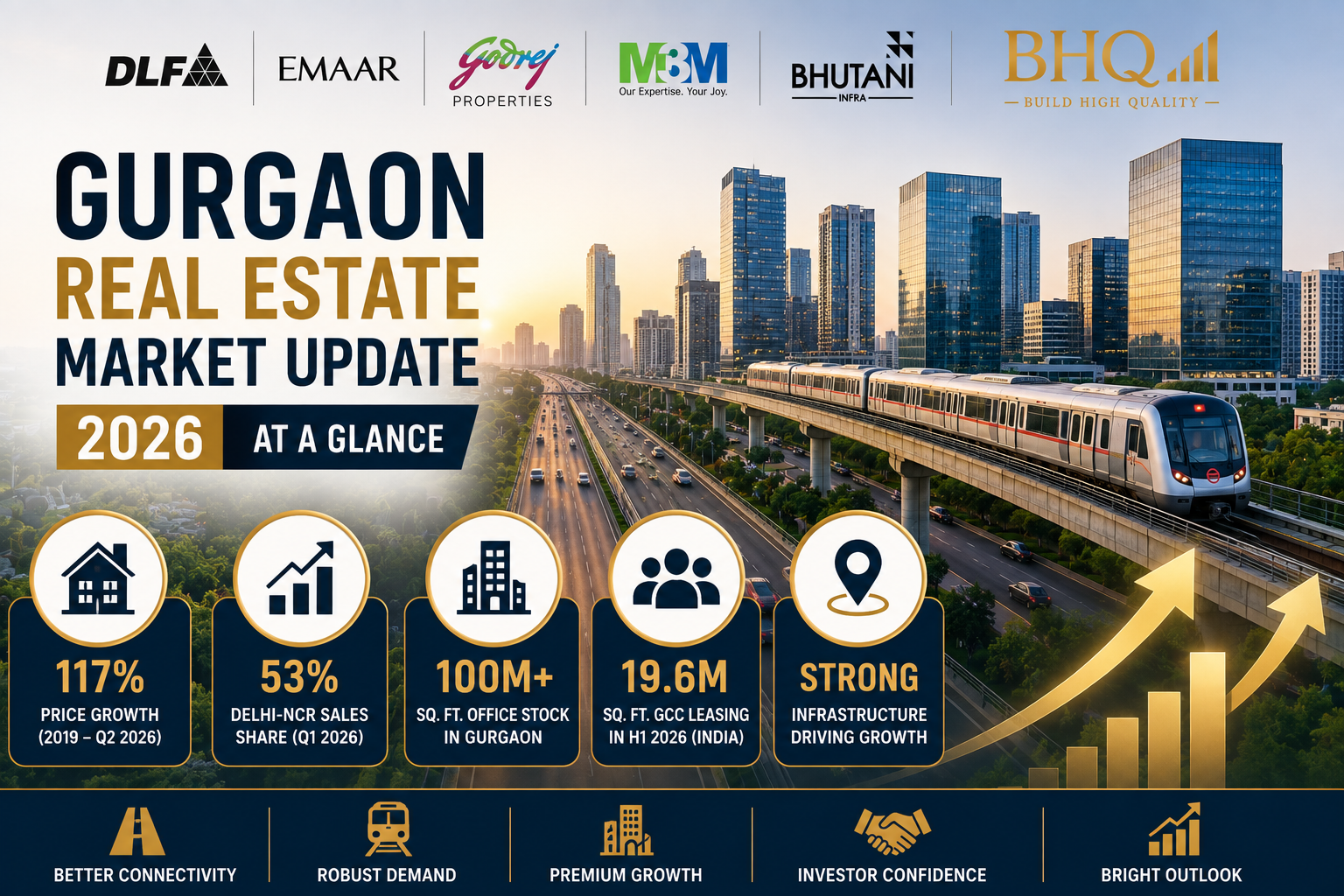
According to ANAROCK data reported in August 2026, Gurugram residential property prices increased by approximately 117% between 2019 and Q2 2026.
At the same time, Gurgaon's office market has crossed a major milestone, with total office stock exceeding 100 million sq. ft., making it North India's largest office market.
These numbers tell an important story.
Gurgaon is no longer simply a fast-growing real estate market.
It is becoming a large, mature and increasingly diversified real estate ecosystem.
But what exactly is happening in 2026?
Let's look at the latest market indicators.
Gurgaon Real Estate at a Glance
Market Indicator | Latest 2026 Update |
Residential price growth | ~117% since 2019 to Q2 2026 |
Gurgaon share of Delhi-NCR residential sales | 53% in Q1 2026 |
Gurgaon share of Delhi-NCR new launches | 58% in Q1 2026 |
Gurugram office stock | 100+ million sq. ft. |
India H1 2026 office absorption | 45.5 million sq. ft. |
India H1 2026 GCC leasing | ~19.6 million sq. ft. |
NCR Q2 2026 residential sales | ~13,350 units |
NCR Q2 2026 new launches | ~11,200 units |
NCR Q2 2026 available inventory | ~89,100 units |
The figures point toward a market with strong activity—but also increasing supply and greater buyer selectivity.
Gurgaon Continues to Lead Delhi-NCR Residential Demand
One of the strongest indicators of Gurgaon's residential position is its share of Delhi-NCR sales.
JLL's Q1 2026 residential data showed that Gurgaon accounted for 53% of quarterly residential sales in Delhi-NCR.
Gurgaon also accounted for approximately 58% of new residential launches in the region during the quarter.
This demonstrates that developers continue to see substantial demand in the Gurgaon market.
The city's appeal comes from a combination of:
- Corporate employment
- Infrastructure
- Premium housing
- Established neighbourhoods
- New residential corridors
- Retail and lifestyle infrastructure
- Connectivity with Delhi and the wider NCR
However, strong sales do not mean every project or location performs equally.
Micro-market selection remains important.
Residential Prices Have Seen Significant Appreciation
One of the biggest Gurgaon real estate stories of recent years has been price appreciation.
ANAROCK data reported in August 2026 indicates that Gurugram residential prices rose approximately 117% between 2019 and Q2 2026.
This represents a significant increase over a relatively short period.
Several factors have contributed to the broader rise in Gurgaon housing values, including:
- Strong employment ecosystem
- Premium housing demand
- Infrastructure development
- Limited availability in established locations
- New project launches
- Increasing buyer preference for branded developments
- Growth of luxury and ultra-luxury housing
But past appreciation should not be interpreted as a guarantee of future returns.
Real estate markets move through different cycles.
The important question for today's buyer is:
What fundamentals support the current price?
Premium Housing Continues to Lead the Market
The Gurgaon market is increasingly skewed toward premium housing.
JLL's Q1 2026 national residential data showed particularly strong demand in homes priced above ₹1 crore, with the ₹1.5–3 crore segment recording the strongest growth among premium categories.
The broader trend is also visible in Gurgaon.
Buyers are increasingly looking for:
- Larger homes
- Better locations
- Premium amenities
- Privacy
- Better construction quality
- Lifestyle facilities
- Branded developments
- Improved connectivity
This is changing the nature of residential development.
The market is increasingly competing on quality and experience, not just unit size.
Gurgaon's Luxury Market Is Reaching New Levels
The city's premium housing market continues to attract extremely high-value transactions.
A recent example is the reported ₹271 crore purchase of a penthouse at DLF's The Dahlias, described by multiple reports as a record single-unit residential transaction in India.
The transaction involved a penthouse with approximately:
- 17,200 sq. ft. super area
- 10,500 sq. ft. carpet area
While a single luxury transaction should not be treated as a measure of the entire Gurgaon market, it demonstrates the depth of demand for ultra-premium residential assets in the city.
It also highlights an important shift:
Gurgaon is increasingly competing in India's luxury real estate segment.
Office Real Estate Has Crossed a Major Milestone
Residential real estate isn't the only story.
Gurgaon's commercial market has reached a major milestone with more than 100 million sq. ft. of office stock.
This makes Gurugram the largest office market in North India.
The scale of this market is significant.
It means Gurgaon has developed into a major corporate ecosystem supporting:
- Multinational companies
- Indian corporates
- Technology firms
- BFSI companies
- Consulting businesses
- Global Capability Centres
- Flexible workspace operators
- Startups
This commercial ecosystem also supports the residential and retail markets.
Employees need homes.
Businesses need services.
Consumers need restaurants and retail.
This creates interconnected real estate demand.
GCCs Are One of the Biggest Office Demand Drivers
Global Capability Centres have become an important component of India's office market.
CBRE reported that GCCs leased approximately 19.6 million sq. ft. during H1 2026, representing around 43% of total office leasing during the period.
GCC activity is particularly relevant for cities such as Gurgaon because these operations often require sophisticated commercial environments.
They may need:
- High-quality offices
- Strong digital infrastructure
- Employee amenities
- Large floor plates
- Connectivity
- Sustainability
- Access to skilled talent
This supports the broader shift toward premium office development.
Flexible Workspaces Are Changing Office Demand
Another major development is the growth of flexible workspace operators.
CBRE reported that flexible workspace operators accounted for 27% of India's quarterly office leasing in Q2 2026, making them the largest occupier category during the quarter.
This reflects a major change in how companies think about office space.
Businesses increasingly want:
- Flexibility
- Scalability
- Managed offices
- Shorter commitments
- Plug-and-play environments
- Hybrid workplace options
For Gurgaon, this creates another layer of demand for well-designed commercial properties.
Green Buildings Are Becoming More Important
Commercial real estate is also becoming more sustainability-focused.
CBRE reported that 76% of office completions in India during Q2 2026 were green-certified, while 73% of leasing activity was concentrated in green-certified buildings.
This suggests sustainability is moving beyond being simply an environmental consideration.
It can influence:
- Occupier preferences
- Operational efficiency
- Employee experience
- Corporate ESG goals
- Long-term building relevance
For future commercial developments in Gurgaon, sustainability is likely to become an increasingly important consideration.
New Supply Is Also Increasing
A strong market attracts developers.
That means buyers also need to pay attention to supply.
Across the top seven Indian residential markets, ANAROCK reported approximately 1.06 lakh new launches in Q2 2026, up 7% year-on-year.
NCR accounted for approximately 11,200 new launches during the quarter.
At the same time, available NCR inventory stood at approximately 89,100 units.
This creates an important market dynamic:
Demand is strong, but supply is also expanding.
For buyers, this can actually be positive.
More choice means greater ability to compare:
- Location
- Developer
- Pricing
- Specifications
- Amenities
- Delivery timelines
- Project quality
It also means developers have to compete more effectively for buyers.
New Project Approvals Show Continued Developer Confidence
Gurgaon's development pipeline remains active.
According to recent reporting, Gurugram RERA approved 51 real estate projects worth approximately ₹38,000 crore during H1 2026, with 11 marquee projects accounting for roughly ₹25,000 crore of the reported investment.
The Haryana RERA project database also shows multiple Gurugram projects receiving registrations and approvals during 2026 across residential and commercial categories.
This is a strong indication that developers continue to see long-term potential in the city.
But more supply also reinforces the need for careful project selection.
Different Gurgaon Corridors Are Developing at Different Speeds
Gurgaon should not be treated as a single market.
Different corridors have different characteristics.
Established business districts
These benefit from existing corporate ecosystems and mature infrastructure.
Dwarka Expressway
This corridor has become an important residential and commercial development zone.
Golf Course Road
A mature premium residential and commercial corridor.
Golf Course Extension Road
An expanding residential and commercial catchment.
Sohna Road
A major residential corridor with supporting commercial activity.
SPR
An important connectivity corridor with expanding development.
Newer sectors
These may offer future growth potential but can also involve greater development and execution risk.
For investors, the right approach is to analyse the micro-market rather than simply buying into the Gurgaon brand.
Infrastructure Remains a Major Market Driver
Infrastructure continues to influence Gurgaon's real estate map.
Better connectivity can improve access to:
- Delhi
- Airport
- Corporate districts
- Residential areas
- Retail destinations
- Emerging sectors
But infrastructure should be evaluated carefully.
Investors should distinguish between:
Operational infrastructure
Infrastructure under construction
Proposed infrastructure
A proposed road or metro line should not be treated as an assured benefit until its status and execution are verified.
Commercial Real Estate Is Becoming More Selective
Gurgaon's commercial market is strong, but investors should not assume that every commercial property will perform equally well.
The market increasingly rewards properties with:
- Strong connectivity
- Good visibility
- Quality construction
- Relevant catchment
- Strong tenant demand
- Good parking
- Efficient layouts
- Professional management
- Sustainable design
This is particularly important as Gurgaon develops more commercial inventory.
Quality and location increasingly matter together.
Residential Buyers Are Becoming More Selective Too
The same principle applies to housing.
A rising market does not mean buyers should purchase any available property.
Today's buyer is increasingly comparing:
- Developer track record
- Construction quality
- Location
- Floor plans
- Amenities
- Density
- Maintenance
- Delivery schedule
- Total acquisition cost
- Future surrounding development
The result is a more informed market.
What Is Driving Gurgaon's Real Estate Market?
The city's growth is not dependent on one factor.
It is being supported by several interconnected drivers.
Corporate employment
Gurgaon's established business ecosystem supports housing and commercial demand.
GCC expansion
Global companies continue to expand strategic operations in India.
Infrastructure
Road and transport improvements continue to reshape accessibility.
Premium housing
Higher-income buyers continue to support premium and luxury residential demand.
Commercial development
Gurgaon's office stock has crossed 100 million sq. ft.
Population growth
New residential communities expand the local consumer base.
Retail and lifestyle
Restaurants, entertainment, healthcare and services increasingly follow residential and office growth.
These factors reinforce one another.
What Could Slow the Market?
A balanced market update should also consider risks.
Real estate is not a one-way market.
Potential challenges include:
Higher prices
Rapid appreciation can make affordability more difficult.
Rising supply
Too much new inventory can increase competition.
Economic uncertainty
Corporate expansion can change with global economic conditions.
Interest rates
Financing costs influence buyer affordability.
Infrastructure delays
Projects can take longer than expected.
Speculative buying
Rapid price increases can encourage short-term speculation.
Micro-market oversupply
A strong city-level market does not protect every individual project from excess local supply.
These factors make due diligence important.
What Should Buyers Watch for the Rest of 2026?
Several indicators deserve attention.
Residential sales
Are buyer volumes continuing to support new launches?
Price movement
Are prices rising because of genuine demand or simply because of limited supply?
New inventory
How much new housing is entering each micro-market?
Office leasing
Does corporate and GCC demand continue to support office absorption?
Rental market
Are rents moving alongside capital values?
Infrastructure
Which projects are actually progressing?
Commercial supply
Is new commercial inventory being absorbed?
Developer launches
Are developers moving toward premium, mixed-use and experience-led formats?
These indicators can help buyers understand whether a particular micro-market is strengthening or becoming more competitive.
What Does the Current Market Mean for Investors?
The latest data suggests that Gurgaon remains a compelling market to watch.
But the investment strategy should be more selective than simply:
"Buy because Gurgaon is growing."
Instead, investors should ask:
- Is there genuine demand?
- Is the location well connected?
- Is the price supported by fundamentals?
- How much competing supply is coming?
- Is the developer credible?
- What is the property's intended use?
- What is the likely user or tenant profile?
- What are the total ownership costs?
- How easy might the property be to exit?
These questions are particularly important after a period of significant price appreciation.
What Does This Mean for BHQ Realty?
BHQ Realty is building its presence in Gurgaon across real estate development and commercial property services, including private developments, builder floors, commercial property consulting and investor deal structuring. BHQ Realty
The company's entry into commercial development comes at an interesting point in Gurgaon's real estate cycle.
The market has achieved significant scale.
Office demand remains strong.
Residential demand is concentrated toward quality and premium housing.
Infrastructure continues to expand.
At the same time, supply is increasing and buyers are becoming more selective.
For a developer, this creates an important responsibility:
Build for genuine demand rather than simply adding inventory.
That means understanding:
- Location
- User behaviour
- Connectivity
- Commercial demand
- Design
- Quality
- Sustainability
- Long-term usability
These principles can help create projects that remain relevant as the market evolves.
Gurgaon Real Estate Market: The Big Picture
The latest data paints a nuanced picture.
Residential
Strong, premium-led and increasingly selective.
Commercial
Large and expanding, with Gurgaon's office stock now exceeding 100 million sq. ft.
GCCs
A major driver of office demand nationally, with H1 2026 leasing of about 19.6 million sq. ft. across India.
Luxury
Gurgaon continues to attract extremely high-value residential transactions.
Supply
New residential and commercial projects continue entering the market.
Prices
Residential values have seen substantial appreciation since 2019, with ANAROCK reporting about 117% growth in Gurugram through Q2 2026.
The market therefore appears strong—but not simple.
Should You Invest in Gurgaon Real Estate in 2026?
There is no universal yes or no answer.
The right decision depends on:
- Investment horizon
- Budget
- Property type
- Location
- Risk appetite
- Financing
- Intended use
- Exit strategy
For someone buying a home for personal use, lifestyle and location may matter most.
For a commercial investor, tenant demand and business fundamentals become more important.
For a long-term investor, surrounding infrastructure and development may deserve greater attention.
The key is to match the asset with the objective.
Final Outlook for Gurgaon Real Estate in 2026
Gurgaon's real estate market has entered a more mature phase.
The city has demonstrated strong residential appreciation, significant premium housing demand and substantial commercial expansion.
Its office market has crossed 100 million sq. ft.
Its residential market continues to dominate Delhi-NCR sales.
GCCs and flexible workspace operators are supporting commercial demand.
New infrastructure is expanding the city's development footprint.
And developers continue to invest heavily in new projects.
But the next phase is unlikely to be about simply owning "Gurgaon property."
It will be about choosing the right micro-market, the right asset and the right project.
For buyers, that means more research.
For investors, it means stronger due diligence.
For developers, it means better planning and execution.
And for BHQ Realty, it represents an opportunity to participate in the city's next chapter with a focus on quality, usability and long-term commercial relevance.
Gurgaon has already grown into a major real estate market.
The next question is how intelligently that growth will be developed.
Frequently Asked Questions
What is the current Gurgaon real estate market trend in 2026?
Gurgaon's market remains active, with strong premium residential demand, significant price appreciation since 2019 and continued commercial expansion. Gurgaon also accounted for 53% of Delhi-NCR residential sales in Q1 2026.
Have Gurgaon property prices increased in 2026?
Gurugram has recorded substantial multi-year appreciation. ANAROCK data reported in August 2026 indicates approximately 117% growth in residential property prices between 2019 and Q2 2026.
How large is Gurgaon's office market?
Gurgaon's office stock has crossed 100 million sq. ft., making it the largest office market in North India.
Is commercial real estate growing in Gurgaon?
Yes. Gurgaon's large office ecosystem, corporate occupier base, GCC activity and flexible workspace demand continue to support commercial real estate.
Is Gurgaon still attracting new real estate projects?
Yes. Haryana RERA's database shows multiple new Gurugram projects receiving registrations and approvals during 2026, while recent reporting indicates substantial project approvals during H1 2026.
What should buyers consider before investing in Gurgaon?
Buyers should evaluate location, connectivity, developer track record, project approvals, demand, competing supply, pricing, total costs and their own investment horizon.
Is past Gurgaon price appreciation a guarantee of future returns?
No. Historical appreciation does not guarantee future performance. Real estate values can be affected by supply, demand, economic conditions, infrastructure, interest rates and local market dynamics.