Gurgaon's real estate market continues to attract significant attention in 2026, but the nature of the market is evolving.
The city is no longer simply expanding through new residential projects and office buildings. It is developing into a more mature real estate ecosystem where commercial demand, infrastructure, workplace quality, sustainability and investment capital are increasingly interconnected.
One of the biggest recent milestones is the size of Gurgaon's office market.
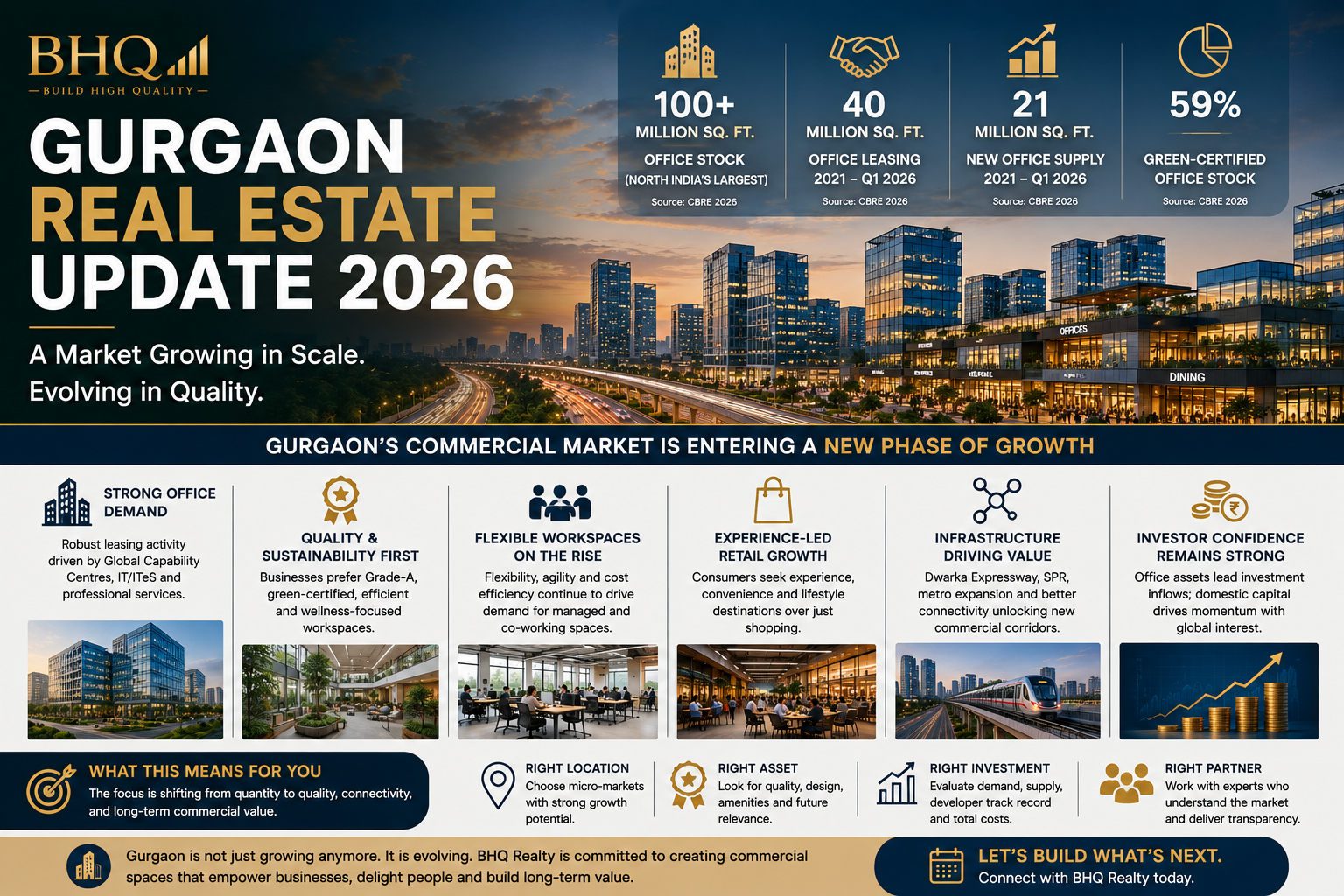
According to CBRE data reported in July 2026, Gurugram's total office stock has crossed 100 million sq. ft., making it the largest office market in North India. Between 2021 and Q1 2026, the city recorded approximately 40 million sq. ft. of office leasing while around 21 million sq. ft. of new office space was added.
This milestone provides an important indication of the city's commercial strength.
But the more interesting story is what happens next.
Gurgaon's Real Estate Market Is Moving From Expansion to Maturity
For years, Gurgaon's real estate story was primarily about rapid development.
New sectors emerged.
Residential communities expanded.
Corporate offices followed.
Infrastructure improved.
Retail and lifestyle destinations grew around them.
Today, the city has reached a scale where the focus is increasingly shifting from quantity to quality.
Businesses are becoming more selective about office environments.
Consumers are looking for better retail experiences.
Investors are becoming more conscious of asset quality and location.
Developers are increasingly expected to deliver projects that remain relevant over the long term.
This marks an important transition for commercial real estate in Gurgaon.
1. Gurgaon Has Crossed the 100 Million Sq. Ft. Office Milestone
The biggest commercial real estate update is undoubtedly the scale of Gurgaon's office market.
Crossing 100 million sq. ft. of office stock places Gurgaon firmly among India's major corporate real estate markets.
The city has also recorded substantial leasing activity over recent years, demonstrating continued occupier demand. CBRE data indicates that international occupiers alone leased more than 17 million sq. ft. during the period covered by its latest assessment.
This matters because office demand is closely connected to:
- Employment
- Corporate expansion
- Global Capability Centres
- Professional services
- Technology
- Flexible workspaces
- Supporting retail and hospitality
As businesses grow, demand extends beyond offices themselves.
Employees need restaurants.
Companies need hotels.
Businesses need services.
Professionals need cafés, healthcare and lifestyle facilities.
This creates a broader commercial ecosystem.
2. Grade-A and Sustainable Assets Are Gaining Importance
Gurgaon's commercial market is also becoming more quality-conscious.
CBRE data indicates that around 59% of Gurgaon's office stock is green-certified, while approximately one-third is institutionally owned.
This indicates a structural shift toward more institutional-grade commercial assets.
For businesses, building quality can influence:
- Employee experience
- Operational efficiency
- Corporate image
- Sustainability goals
- Workplace attractiveness
For investors, better-quality assets can potentially provide access to a broader pool of occupiers.
However, quality should always be evaluated alongside location, demand, pricing and supply.
A premium building in the wrong micro-market is not automatically a better investment.
3. Commercial Investment Remains Strong
Another important 2026 update is the continued strength of investment into real estate.
Colliers reported that India's office sector accounted for more than 40% of overall real estate investment inflows during H1 2026. Domestic capital increased 80% year-on-year and represented approximately 57% of total investment inflows, while foreign capital also increased 24% year-on-year.
This is significant for the wider commercial real estate market.
It suggests that investors continue to see office assets as an important institutional real estate category.
At the same time, Colliers notes that investors in India are increasingly expanding beyond traditional office assets toward mixed-use and alternative real estate opportunities.
That trend is particularly relevant to Gurgaon.
4. Mixed-Use Development Is Becoming More Relevant
Modern commercial real estate is increasingly about creating ecosystems rather than isolated buildings.
A successful destination may combine:
Office + Retail + Dining + Lifestyle + Public Spaces
This model can create multiple reasons for people to visit a development.
Employees can work there.
Customers can shop there.
Families can dine there.
Businesses can use nearby services.
Visitors can spend more time within the destination.
Recent commercial development in Gurgaon also reflects this direction, with projects increasingly being positioned around integrated office, retail, dining and entertainment experiences.
For developers, the challenge is to ensure these components complement one another rather than simply placing different uses next to each other.
5. The Office Market Is Becoming More Experience-Driven
Another important change is the way companies evaluate workplaces.
The office is no longer simply a place where employees sit and work.
Businesses increasingly consider:
- Employee experience
- Collaboration
- Wellness
- Natural light
- Amenities
- Accessibility
- Flexible layouts
- Sustainability
This is consistent with the broader movement toward human-centric commercial design.
For Gurgaon, this is particularly important because the city competes for major employers and skilled professionals.
A workplace's environment can increasingly become part of the employer experience.
6. Flexible Workspaces Continue to Influence Gurgaon
Flexible workspace operators remain an important part of India's commercial real estate market.
Delhi-NCR's office market recorded strong leasing activity in early 2026, with flexible workspace operators accounting for a significant share of quarterly absorption. Gurugram remained the dominant office destination in the region.
Flexible workspaces are relevant because they demonstrate the growing demand for adaptability.
Businesses may need:
- Smaller offices during early growth
- Larger spaces as teams expand
- Shorter commitments
- Plug-and-play environments
- Meeting facilities
- Shared amenities
Commercial developments that can accommodate different business requirements may therefore have greater flexibility in attracting occupiers.
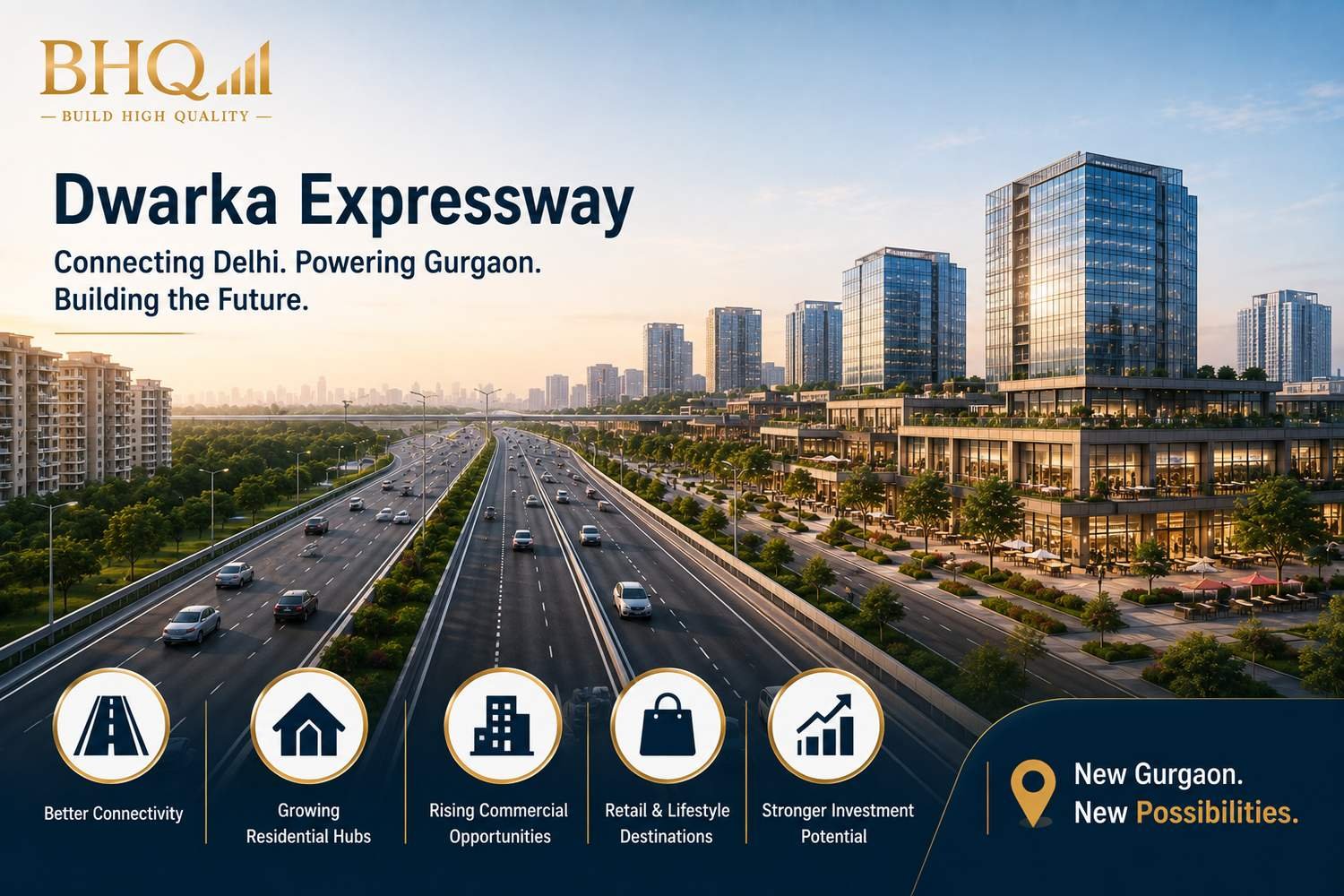
7. Infrastructure Continues to Shape the Market
Gurgaon's real estate market cannot be understood without considering infrastructure.
Major corridors and infrastructure initiatives continue to influence how people and businesses move through the city.
Connectivity affects:
- Employee commutes
- Customer accessibility
- Business visibility
- Logistics
- Catchment areas
- Development potential
This is particularly important for emerging commercial locations.
A micro-market can change considerably when its accessibility improves.
But infrastructure should be viewed as one part of the investment equation—not as a guarantee of appreciation or rental returns.
8. Residential and Commercial Real Estate Continue to Support Each Other
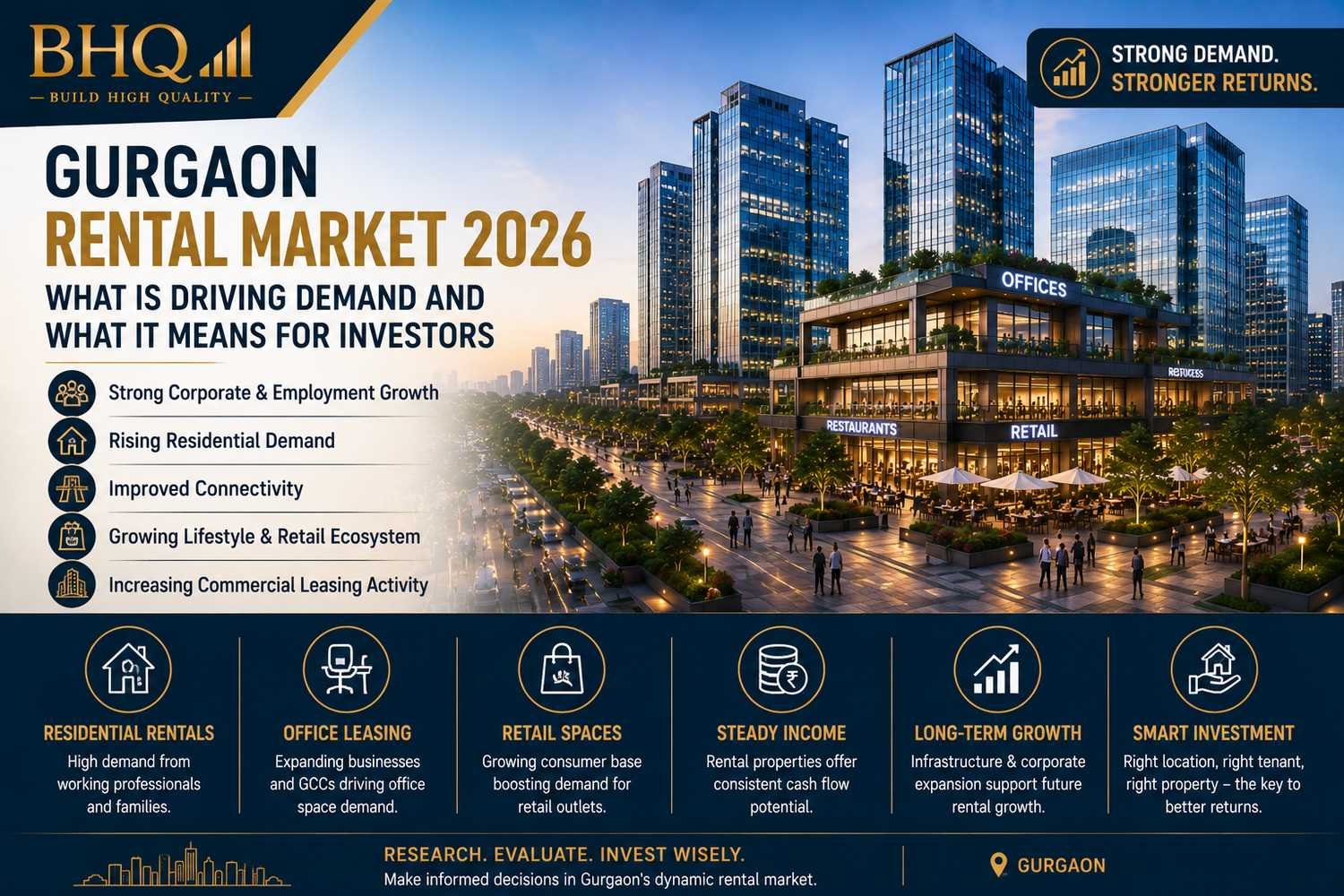
Gurgaon's residential growth is another important component of the commercial story.
Every growing residential catchment creates demand for local services.
Residents need:
- Restaurants
- Cafés
- Grocery stores
- Healthcare
- Fitness
- Salons
- Banks
- Professional services
- Entertainment
This creates opportunities for neighbourhood retail and mixed-use developments.
The relationship is simple:
More residents → more consumption → more businesses → more commercial demand.
This is why investors should always examine the population and development around a commercial project.
9. Gurgaon Continues to Attract Premium Real Estate Demand
The city's premium residential market also remains active.
A recent example is the reported ₹271 crore purchase of a penthouse at DLF's The Dahlias in Gurgaon, a transaction described as one of India's most expensive single-unit residential property deals.
While a luxury residential transaction should not be used as a direct indicator of commercial investment performance, it does demonstrate the depth of premium real estate demand in Gurgaon.
The city is increasingly serving multiple segments:
Corporate + Residential + Luxury + Retail + Hospitality + Lifestyle
That diversification strengthens its position as a major urban real estate market.
10. Investors Need to Look Beyond Headlines
A strong market does not mean every property is a strong investment.
This is perhaps the most important message for anyone reading a Gurgaon real estate update.
Investors should examine:
Location
What is the exact micro-market?
Connectivity
How accessible is the property today?
Infrastructure
What infrastructure is operational and what is only proposed?
Demand
Who will actually use the property?
Supply
How much competing inventory exists?
Project Quality
What are the specifications, amenities and planning standards?
Developer
What is the developer's execution record?
Financials
What are the actual acquisition, maintenance and holding costs?
Exit Potential
Who is likely to buy the property from you in the future?
This approach is far more useful than simply following headlines about price appreciation.
What Does This Real Estate Update Mean for Commercial Investors?
The current market points toward several broad themes.
Quality matters more.
As the market matures, premium and institutional-grade assets are increasingly important.
Connectivity matters more.
Accessibility remains a fundamental factor for both businesses and consumers.
Experience matters more.
Office and retail spaces are increasingly being designed around the people who use them.
Flexibility matters more.
Businesses want commercial environments that can adapt to changing requirements.
Transparency matters more.
Investors need clear information about project fundamentals rather than only promotional return projections.
Diversification matters more.
Institutional investors are increasingly looking beyond traditional office assets toward mixed-use and alternative opportunities.
BHQ Realty's Perspective
For BHQ Realty, these developments come at an important stage in its growth.
The company is expanding its presence in Gurgaon and preparing to introduce its first commercial project in the city.
BHQ Realty's current positioning includes private developments, builder floors, commercial property consulting and investor deal structuring. BHQ Realty
The current market provides a clear lesson:
The future of commercial development is not simply about creating more inventory.
It is about creating better commercial environments.
That means understanding:
- Where people are moving
- Where businesses are expanding
- How infrastructure is evolving
- What customers expect
- What modern workplaces require
- What investors value
- How a development can remain relevant over time
This philosophy aligns closely with BHQ Realty's focus on building quality and creating long-term value.
Gurgaon Real Estate: What to Watch Next
As we move through 2026, several themes deserve attention.
Office leasing
Will corporate and GCC demand continue to support office absorption?
Premium commercial assets
Will demand increasingly concentrate around Grade-A and institutional-quality developments?
Mixed-use projects
Will integrated office, retail and lifestyle destinations become more prominent?
Infrastructure
Which emerging corridors will gain greater commercial relevance?
Retail
Will experience-led and neighbourhood retail continue to expand?
Investment
Will domestic and international capital continue to favour Indian commercial real estate?
Sustainability
Will green-certified and wellness-oriented buildings become increasingly important to occupiers?
These developments will help shape the next chapter of Gurgaon's real estate market.
Final Takeaway
The latest Gurgaon real estate update points toward a market that is large, active and increasingly mature.
The city has crossed a major office-market milestone, investment into Indian real estate remains strong, and commercial occupiers are increasingly looking for quality, connectivity, flexibility and better experiences.
For investors, this means the opportunity is not simply about being present in Gurgaon.
It is about choosing the right location, right asset, right development and right commercial ecosystem.
For developers, it means creating projects that can respond to changing business and consumer expectations.
And for BHQ Realty, its entry into commercial development comes at a time when Gurgaon is moving into its next phase.
Gurgaon isn't just growing anymore. It is evolving.
And the next generation of real estate will be defined by how intelligently that growth is shaped.
FAQ
What is the latest Gurgaon real estate update in 2026?
Gurgaon's commercial market remains active, with office stock crossing 100 million sq. ft., strong leasing activity and continued investor interest in Indian commercial real estate.
Is Gurgaon still a strong commercial real estate market?
Gurgaon remains a major commercial market in North India, with substantial office stock, corporate occupier demand and continued investment activity.
What is changing in Gurgaon commercial real estate?
The market is increasingly focused on Grade-A quality, sustainability, workplace experience, connectivity, flexible spaces and mixed-use commercial environments.
What should investors look for in Gurgaon property?
Investors should examine location, connectivity, demand, supply, project quality, developer credentials, total costs and long-term commercial relevance rather than relying solely on projected returns.
What does BHQ Realty do?
BHQ Realty operates in real estate development and related services, with a focus that includes Gurgaon, private developments, builder floors, commercial property consulting and investor deal structuring.