Gurgaon's retail landscape has changed significantly over the past decade.
The city has moved beyond traditional shopping destinations and developed a diverse retail ecosystem that includes large shopping malls, high-street markets, neighbourhood retail, mixed-use developments, cafés, restaurants and lifestyle destinations.
For businesses and commercial property investors, this creates an important question:
Is high-street retail or a shopping mall the better commercial format?
There is no universal answer.
Both formats serve different customer behaviours, business models and locations.
A premium fashion brand may benefit from a mall environment.
A neighbourhood café may perform better on a high street.
A restaurant may prefer a visible street-facing location with convenient parking.
A lifestyle brand may want the combination of footfall, ambience and complementary businesses found in a well-planned retail destination.
Understanding these differences is therefore important for anyone evaluating retail property in Gurgaon.
What Is High-Street Retail?
High-street retail generally refers to shops, showrooms, restaurants and other customer-facing businesses located along prominent streets or commercial corridors.
The biggest advantage is often visibility.
Customers can see the businesses directly from the road or pedestrian movement.
High-street environments can include:
- Retail shops
- Restaurants
- Cafés
- Salons
- Showrooms
- Banks
- Clinics
- Fitness centres
- Lifestyle businesses
- Convenience stores
The exact format varies from one location to another.
But the underlying idea is straightforward:
The street itself becomes part of the retail experience.
What Is a Shopping Mall?
A shopping mall is a planned retail environment where multiple businesses operate within an integrated property.
A mall typically provides:
- Multiple retail brands
- Restaurants
- Entertainment
- Common areas
- Parking
- Security
- Climate-controlled environments
- Events and promotional activities
One of the biggest strengths of the mall format is aggregation.
A customer may visit for one purpose and discover several other businesses during the same visit.
This creates opportunities for cross-shopping and longer dwell time.
Visibility: High Street Has a Natural Advantage
For many businesses, visibility is extremely valuable.
A high-street shop can potentially benefit from:
- Road frontage
- Signage
- Passing traffic
- Pedestrian movement
- Direct street access
Customers may discover a business simply because they pass it.
This can be particularly useful for:
- Cafés
- Restaurants
- Salons
- Convenience businesses
- Auto-related services
- Local fashion stores
However, visibility depends heavily on the actual location.
Not every high street has strong traffic or customer movement.
Malls Offer a Controlled Retail Environment
Shopping malls provide something high streets often cannot:
A controlled environment.
Customers can shop, dine and spend time in a comfortable setting without dealing directly with traffic, weather or unplanned street conditions.
Malls can also provide:
- Centralised parking
- Security
- Escalators and lifts
- Common seating
- Air conditioning
- Entertainment
- Events
- Brand visibility
This can make the mall environment particularly attractive to larger brands.
Customer Behaviour Is Different
High-street and mall customers may have different reasons for visiting.
A high-street visit can be highly purposeful.
Someone may drive to a particular restaurant, salon or store.
A mall visit can be more exploratory.
Customers may arrive to:
Shop → Eat → Watch a movie → Explore brands → Socialise
This difference in customer behaviour influences the types of businesses that perform well in each format.
Parking Can Make or Break Retail
Parking is one of the most important practical considerations in Gurgaon.
A customer may like a restaurant or store but decide not to visit if parking is difficult.
High streets can sometimes face:
- Limited parking
- Roadside congestion
- Competition for spaces
- Difficult peak-hour access
Well-planned malls generally provide structured parking.
But even malls need to manage parking efficiently during weekends, holidays and peak periods.
For investors, parking should therefore be considered a commercial factor, not merely an infrastructure detail.
Footfall Is Not the Same as Business Demand
Retail discussions often focus on footfall.
But footfall should be analysed carefully.
Suppose a location has a very high number of visitors.
That sounds attractive.
But what if most visitors are not the target customers of your business?
The commercial value of footfall depends on:
Volume + Relevance + Frequency + Spending Capacity
For example:
A premium restaurant may benefit from affluent customers.
A convenience store may benefit from frequent local visits.
A children's activity centre may benefit from nearby families.
A luxury brand may prefer a specific customer profile rather than maximum footfall.
Therefore, quality of footfall matters as much as quantity.
Tenant Mix Can Create a Stronger Ecosystem
One of the biggest advantages of a successful mall or planned commercial destination is tenant mix.
Consider a destination containing:
- Fashion
- Beauty
- Food
- Entertainment
- Lifestyle
- Fitness
- Electronics
Customers have multiple reasons to visit.
This can create a network effect.
One successful business can generate traffic for another.
Restaurants benefit from shopping traffic.
Retailers benefit from entertainment.
Entertainment businesses benefit from dining.
This is one reason commercial ecosystems can be more powerful than isolated retail units.
High Streets Can Benefit From Local Communities
High-street retail has another advantage: proximity.
Neighbourhood businesses can become part of people's everyday routines.
Residents may visit the same:
- Café
- Grocery store
- Salon
- Restaurant
- Pharmacy
- Fitness centre
regularly.
This creates a different kind of customer relationship.
Instead of depending entirely on destination shopping, the business can benefit from recurring local demand.
This is especially relevant in Gurgaon, where large residential communities continue to expand around commercial corridors.
Experience Is Changing Both Formats
The distinction between malls and high streets is becoming less clear.
Modern high streets are becoming more experiential.
Modern malls are becoming more lifestyle-oriented.
Both formats increasingly incorporate:
- Restaurants
- Cafés
- Outdoor seating
- Landscaping
- Entertainment
- Events
- Social spaces
- Wellness
- Premium experiences
The objective is the same:
Give people a reason to spend time in the physical environment.
This is becoming increasingly important as online shopping continues to offer convenience.
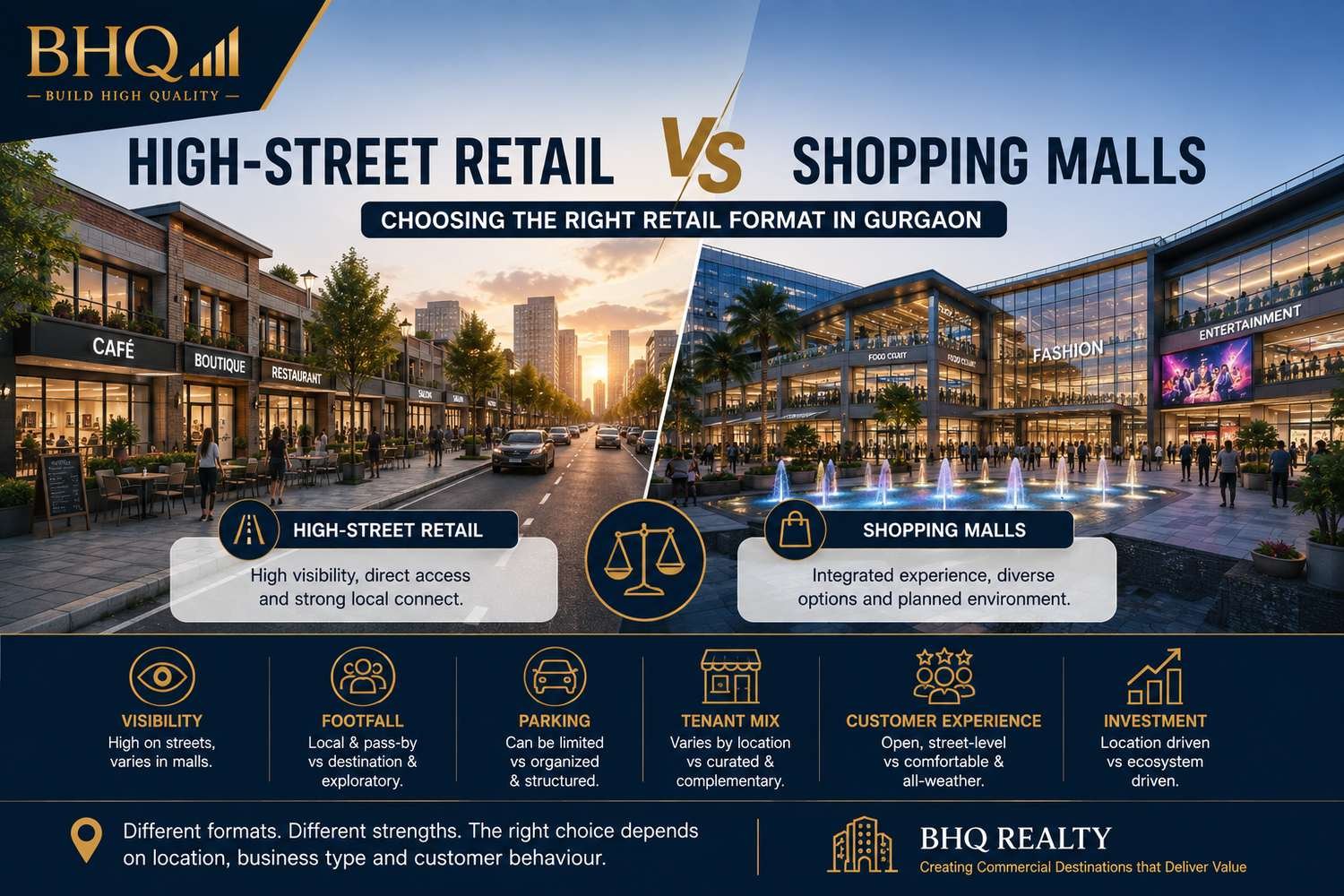
High Street vs Mall: Quick Comparison
Factor | High-Street Retail | Shopping Mall |
Visibility | Often very high | Depends on mall positioning |
Street access | Direct | Controlled |
Parking | Can vary | Usually structured |
Customer discovery | Strong | Strong through tenant mix |
Tenant mix | Usually less controlled | Highly planned |
Environment | Open/street-based | Controlled |
Weather dependency | Higher | Lower |
Entertainment | Usually limited | Often integrated |
Local convenience | Strong | Varies |
Brand ecosystem | Depends on location | Usually stronger |
Neither format automatically wins.
The right choice depends on location, business model and customer profile.
Which Businesses Suit High-Street Retail?
High-street locations can work particularly well for businesses that benefit from visibility and convenience.
Examples include:
Restaurants
Especially those with strong street frontage and parking.
Cafés
Where repeat local customers are important.
Salons and Wellness
Where customers may prefer convenient neighbourhood access.
Convenience Retail
Where proximity is a major factor.
Showrooms
Where visibility and road access can support discovery.
Local Services
Businesses that depend on repeat customers from nearby communities.
Again, performance depends on the specific micro-market.
Which Businesses Suit Shopping Malls?
Malls can be particularly suitable for businesses that benefit from:
- Brand association
- High-quality customer environments
- Large catchments
- Cross-shopping
- Entertainment traffic
- Planned shopping visits
Examples can include:
- Fashion brands
- Electronics
- Lifestyle brands
- Beauty
- Entertainment
- Premium dining
- Large-format retail
The mall environment can help brands become part of a larger destination.
What Should a Retail Investor Look At?
If you're considering commercial property in Gurgaon, the retail format should only be one part of your analysis.
Look at:
Location
Is the property positioned within a strong catchment?
Accessibility
Can customers reach it easily?
Parking
Is there sufficient parking?
Visibility
Can customers see and identify the property?
Footfall
Is the movement relevant to the target business?
Tenant Mix
Are complementary businesses operating nearby?
Competition
How many similar destinations are competing for the same customers?
Supply
How much new retail inventory is expected?
Surrounding Development
Are residential and office populations growing?
Project Quality
Is the property well planned and maintained?
These factors can be more important than simply choosing "mall" or "high street."
Why Gurgaon Is Particularly Interesting for Retail
Gurgaon's unique combination of corporate offices and large residential communities creates multiple retail demand drivers.
During the week, office workers generate demand.
In the evening, nearby residents become important customers.
On weekends, families and lifestyle consumers can drive activity.
This creates opportunities for different retail formats.
High streets can serve local and convenience-driven demand.
Malls can serve destination shopping and entertainment.
Mixed-use developments can combine elements of both.
This diversity makes Gurgaon one of the more interesting retail markets in the NCR.
The Rise of Mixed Retail Destinations
The next evolution may not be about choosing between high street and mall.
It may be about combining the best elements of both.
Imagine a commercial destination with:
- Street-facing retail
- Open-air cafés
- Premium restaurants
- Landscaped walkways
- Office spaces
- Convenient parking
- Lifestyle businesses
- Community areas
Such environments can create a more flexible retail experience.
Customers get the visibility and openness of a high street.
They also receive some of the convenience and organisation associated with a planned development.
This is where modern mixed-use commercial development can become particularly relevant.
What This Means for BHQ Realty
BHQ Realty is expanding its Gurgaon presence across real estate development and commercial property services, with its first commercial project in Gurgaon forming an important part of its development journey. BHQ Realty
The evolution of retail provides an important lesson for developers:
Commercial space should be designed around customer behaviour.
It is not enough to create retail units.
A successful commercial destination needs to consider:
- How people arrive
- Where they park
- What they see first
- How they move through the project
- Where they spend time
- What businesses complement each other
- What makes customers return
This people-first approach can help create more meaningful commercial environments.
The Future of Retail in Gurgaon
The future is unlikely to belong exclusively to malls or high streets.
Instead, different formats may continue to serve different purposes.
High streets
Can remain strong for visibility, convenience and neighbourhood demand.
Malls
Can continue to provide organised shopping, entertainment and brand experiences.
Mixed-use developments
Can combine offices, retail, dining and lifestyle.
Neighbourhood retail
Can benefit from expanding residential communities.
The winning format will ultimately depend on location + customer + business model + experience.
Conclusion
The debate between high-street retail and shopping malls is not really about which format is universally better.
It is about understanding what customers want and what businesses need.
High streets can offer:
Visibility + accessibility + convenience
Malls can offer:
Experience + brand ecosystem + organised infrastructure
Modern mixed-use destinations can potentially combine elements of both.
For investors evaluating retail property in Gurgaon, the most important question should therefore not be:
"Mall or high street?"
It should be:
"Which format is best suited to this location, customer base and business demand?"
As Gurgaon continues to evolve, retail destinations that understand customer behaviour, accessibility and experience will become increasingly important.
And for developers like BHQ Realty, the opportunity is to create commercial spaces that are not simply places to transact but places where people want to spend time.
Frequently Asked Questions
Is high-street retail better than a mall in Gurgaon?
Neither is universally better. High streets can benefit from visibility and convenience, while malls can offer organised infrastructure, entertainment and a strong tenant ecosystem.
Is high-street property a good commercial investment?
It can be attractive when supported by strong visibility, accessibility, relevant customer demand and a healthy surrounding catchment. Each property should be evaluated individually.
Why is parking important for retail property?
Convenient parking can significantly influence customer experience, especially for restaurants, shopping destinations and other businesses where customers may spend extended periods.
What makes a retail location successful?
Important factors include customer catchment, accessibility, visibility, relevant footfall, tenant mix, parking, surrounding development and competition.
Is Gurgaon suitable for retail investment?
Gurgaon's combination of residential growth, corporate offices, infrastructure and lifestyle demand creates opportunities across different retail formats. However, individual projects and locations require detailed evaluation.
What is BHQ Realty's commercial focus?
BHQ Realty is a Gurgaon-focused real estate company involved in development and commercial property services and is preparing to introduce its first commercial project in Gurgaon.