Real estate and infrastructure have always been closely connected.
Build a road, improve connectivity and reduce travel time and an area can become more accessible to people and businesses.
This relationship is particularly visible in Gurgaon.
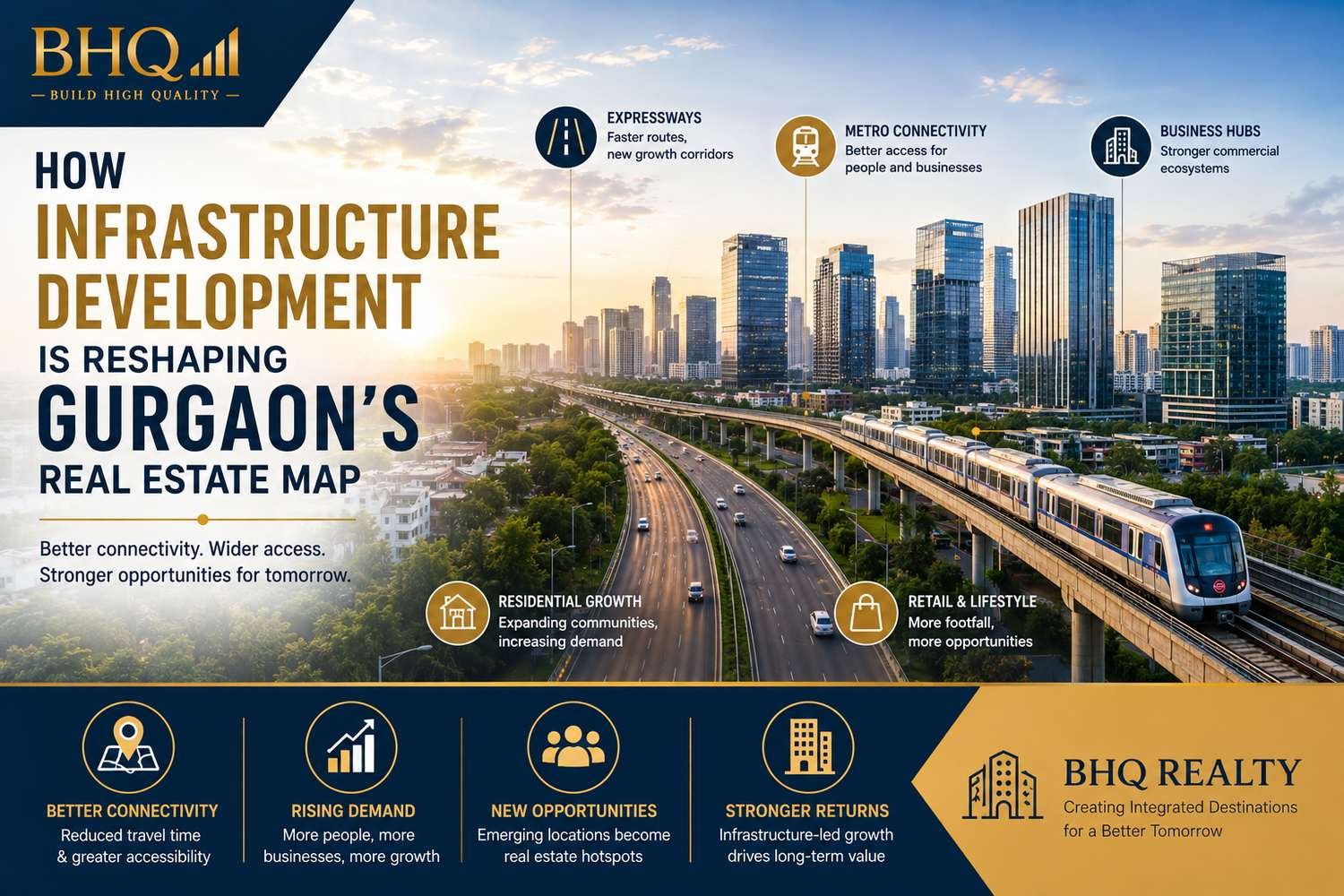
Over the years, the city's transformation from a corporate suburb into a major business and residential destination has been supported by highways, expressways, arterial roads, metro connectivity and expanding urban infrastructure.
Today, Gurgaon is entering another phase of development.
New infrastructure corridors are changing travel patterns, connecting emerging sectors and influencing where businesses, residents and commercial developments choose to locate.
For anyone evaluating commercial property in Gurgaon, understanding this infrastructure story is therefore essential.
But there is an important distinction:
Infrastructure can create opportunity, but infrastructure alone does not guarantee real estate success.
Location, demand, supply, accessibility, development quality and economic activity all matter.
Why Infrastructure Matters to Real Estate
- Consider a location that takes 45 minutes to reach from a major business district.
- Now imagine a new road reduces that journey substantially.
- The location becomes more accessible.
- More people may consider living there.
- Businesses may find it easier to operate there.
- Retailers may gain access to a larger catchment.
- Developers may find the area more attractive.
This creates a chain reaction:
Better connectivity → greater accessibility → wider catchment → increased activity → potential real estate demand
The actual impact varies by location and project, but the relationship is important.
Dwarka Expressway Is Changing Gurgaon's Connectivity
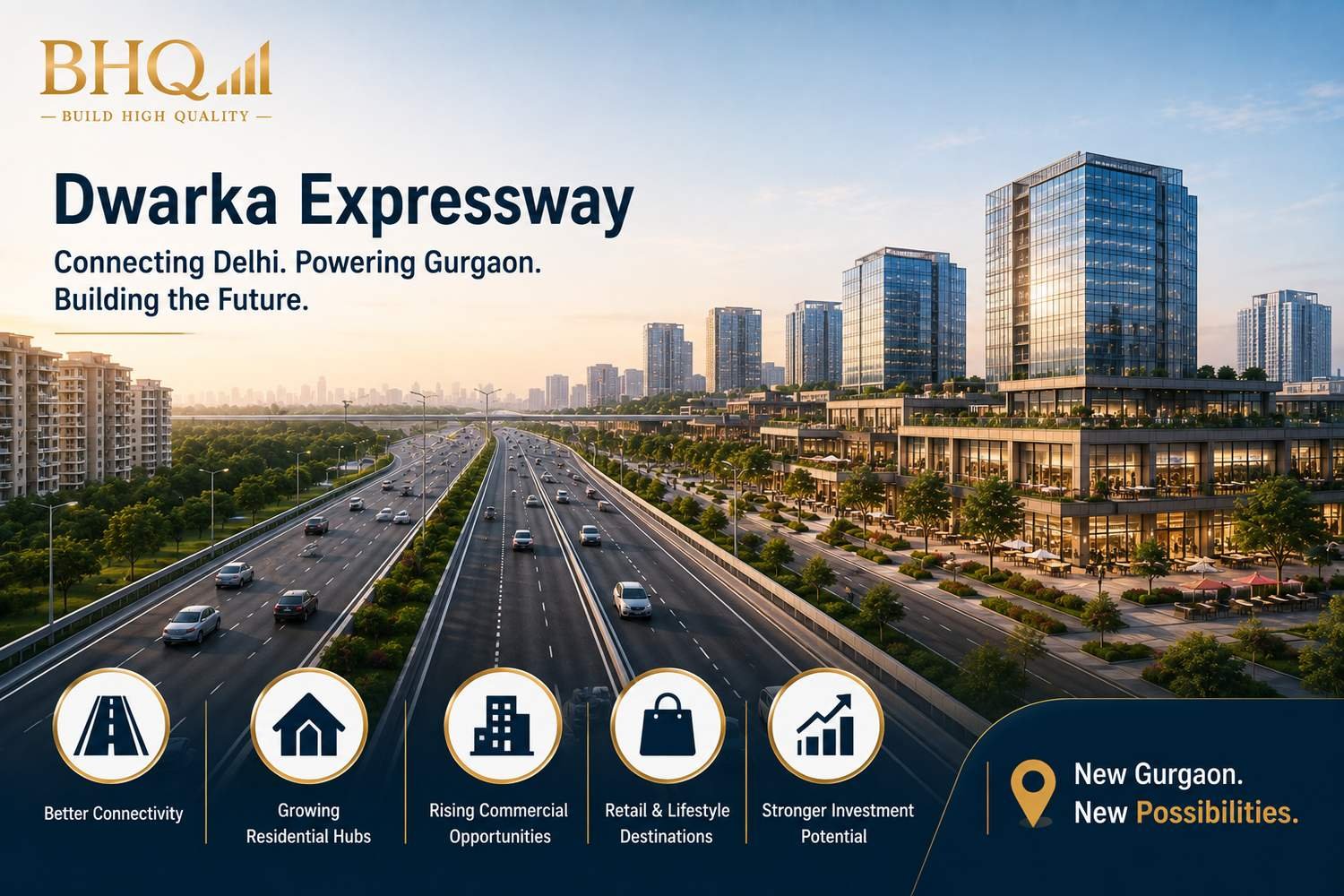
Dwarka Expressway has become one of the most important infrastructure corridors influencing the Gurgaon real estate landscape.
Its connectivity between Delhi and Gurugram has supported significant residential and commercial development along surrounding areas.
The corridor has also changed how several emerging sectors connect with Delhi and other parts of the NCR.
For real estate investors, however, proximity to an expressway should not be viewed as the only factor.
A property should also be evaluated for:
- Actual access points
- Travel time
- Internal roads
- Surrounding development
- Commercial activity
- Parking
- Public transportation
- Existing demand
The strongest opportunities are generally created when infrastructure and genuine market demand develop together.
Golf Course Road and Golf Course Extension Road
Golf Course Road has established itself as one of Gurgaon's prominent premium business and residential corridors.
Its surrounding ecosystem includes:
- Corporate offices
- Luxury residential developments
- Retail
- Restaurants
- Hospitality
- Lifestyle businesses
Golf Course Extension Road has also developed significantly, creating new residential and commercial catchments.
The lesson for investors is important.
Infrastructure doesn't simply connect destinations.
It can help create new real estate corridors.
As areas become easier to access, businesses and residents may gradually move outward from established locations.
Southern Peripheral Road Is Creating New Possibilities
Southern Peripheral Road, or SPR, is another important part of Gurgaon's evolving connectivity network.
The corridor connects several major areas of Gurgaon and provides access toward important highways and business districts.
Its importance extends beyond transportation.
Infrastructure corridors often become development corridors.
As accessibility improves, surrounding land can become more attractive for:
- Residential projects
- Offices
- Retail
- Warehousing
- Hospitality
- Mixed-use developments
But again, investors should examine the exact micro-market rather than assuming that every property along a major road will perform equally.
Metro Connectivity Can Influence Real Estate Demand
Public transportation is particularly important for commercial real estate.
A major office development may employ thousands of people.
Not everyone will travel by private vehicle.
Convenient public transportation can therefore expand the potential employee catchment of a commercial location.
Metro connectivity can also improve convenience for:
- Employees
- Customers
- Visitors
- Students
- Service workers
This can make public transportation an important consideration when evaluating future commercial locations.
Infrastructure Changes the Definition of "Nearby"
One of the most interesting effects of infrastructure is that it changes people's perception of distance.
An area that once seemed far away can become much more accessible after a new road or transport connection opens.
This can expand the practical boundaries of a real estate market.
For businesses, it can mean access to a larger workforce.
For retailers, it can mean a broader customer catchment.
For residents, it can mean access to more employment centres.
For developers, it can create new development possibilities.
This is why infrastructure is often closely watched by the real estate industry.
Commercial Real Estate Benefits From Better Accessibility
Commercial property is particularly sensitive to accessibility.
A business needs people.
Those people need to reach the property.
That includes:
- Employees
- Customers
- Clients
- Suppliers
- Vendors
- Business partners
A location that is difficult to access can create friction.
A well-connected location can reduce that friction.
This is especially relevant for:
Office projects
Employee and client accessibility matters.
Retail projects
Customers need convenient access.
Restaurants
Parking and accessibility can influence visits.
Mixed-use developments
Different user groups need efficient movement.
Therefore, infrastructure should be evaluated in relation to the specific use of the property.
Residential Growth and Infrastructure Reinforce Each Other
Infrastructure doesn't only support commercial development.
It can also accelerate residential expansion.
New roads make previously less accessible areas more practical for housing.
As residential communities grow, they create new demand for commercial services.
Residents need:
- Grocery stores
- Restaurants
- Cafés
- Clinics
- Fitness centres
- Salons
- Banks
- Professional services
This creates a cycle:
Infrastructure → Residential growth → Consumer demand → Commercial development
That relationship is particularly visible across rapidly developing parts of Gurgaon.
Office Growth Can Follow Infrastructure
- The same principle applies to offices.
- Businesses need access to talent.
- If an area is difficult for employees to reach, companies may be less willing to locate there.
- Better connectivity can expand the potential workforce.
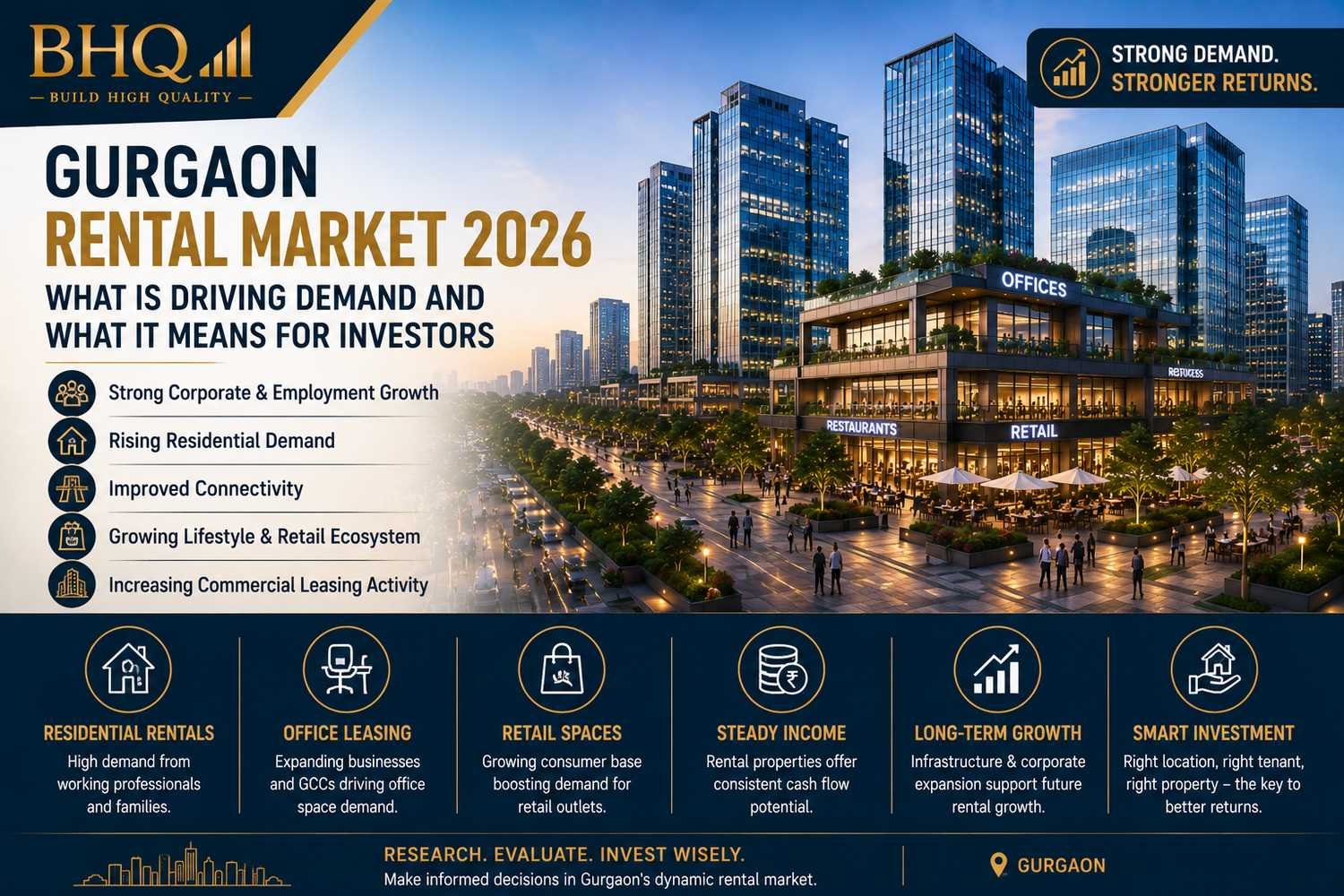
- This becomes particularly important for large organisations and Global Capability Centres, which often require access to substantial skilled talent pools.
- As Gurgaon's office market expands, infrastructure will continue to influence where new commercial clusters develop.
Infrastructure Does Not Automatically Mean Appreciation
This is one of the most important points for investors.
It is tempting to think:
New road = property prices will rise.
Real estate is more complicated.
Infrastructure can improve accessibility, but property performance depends on several additional factors:
- Actual demand
- Development quality
- Supply
- Location
- Economic conditions
- Pricing
- Occupancy
- Competition
- Government policies
A road can improve a location without automatically creating a profitable investment.
Therefore, infrastructure should be treated as one part of the investment analysis.
Existing Infrastructure vs Proposed Infrastructure
When evaluating a property, separate infrastructure into three categories.
Operational
Already available for use.
Under Construction
Currently being developed.
Proposed
Planned but not yet operational.
This distinction matters.
A developer or salesperson may highlight a proposed infrastructure project as a future advantage.
But investors should verify:
- Who is developing it?
- What is its official status?
- What is the expected timeline?
- Where exactly will it connect?
- How directly will the property benefit?
Independent verification is always advisable.
Infrastructure Can Create New Commercial Catchments
A new road can connect two previously separate areas.
That can create a larger commercial catchment.
For example:
A residential community may now become easily accessible to a nearby office district.
Employees from the office district may become customers of businesses in the residential area.
Similarly, businesses may begin opening along the connecting corridor.
Over time, this can create new commercial nodes.
This is one reason developers closely watch infrastructure planning.
What Should Commercial Investors Look For?
If you're evaluating commercial real estate in Gurgaon, infrastructure should form part of your due diligence.
Ask:
How accessible is the property today?
Don't rely only on future infrastructure.
What major roads are nearby?
Understand actual travel routes.
What public transport is available?
Consider employees and customers.
What infrastructure is under construction?
Verify official information.
What areas will become better connected?
Look at the broader network.
Is development already happening?
Infrastructure without surrounding economic activity may take longer to translate into commercial demand.
How much competing supply is coming?
New connectivity can attract new developments too.
The Micro-Market Still Matters
Gurgaon should never be treated as one single real estate market.
Different areas have different characteristics.
For example:
- Established corporate corridors may already have mature office ecosystems.
- Emerging sectors may have stronger future-development narratives.
- Residential-led areas may offer neighbourhood retail opportunities.
- Infrastructure corridors may attract new development over time.
Therefore, investors should always move from:
City → Corridor → Sector → Micro-location → Property
The closer you get to the actual property, the more useful the analysis becomes.
What Infrastructure Means for Retail
- Retail can benefit significantly from accessibility.
- Customers are unlikely to travel long distances for every purchase.
- Convenience matters.
A well-connected commercial destination can potentially serve:
- Nearby residents
- Office workers
- Pass-through traffic
- Visitors
- Families
But retail success still depends on the right catchment and tenant mix.
A convenient location with poor customer relevance may struggle.
A well-targeted location with strong surrounding demand can perform differently.
What Infrastructure Means for Offices
For office properties, accessibility can influence:
- Employee recruitment
- Employee retention
- Client visits
- Business operations
- Corporate location decisions
A company may prefer a location that can be reached from multiple parts of the NCR.
This is particularly important for large employers with employees commuting from different areas.
As Gurgaon's corporate ecosystem continues to grow, connectivity will remain an important factor in commercial location decisions.
What Infrastructure Means for Mixed-Use Development
Mixed-use developments have even more complex connectivity requirements.
They serve:
Employees + Customers + Residents + Visitors
Each group may have different movement patterns.
A well-planned project therefore needs:
- Clear entrances
- Efficient parking
- Pedestrian movement
- Service access
- Public transport connectivity
- Internal circulation
Infrastructure outside the project is important.
But internal planning matters just as much.
Gurgaon’s Real Estate Future Will Be Closely Linked to Connectivity
- The city's next phase of development will not happen randomly.
- Infrastructure will influence where growth occurs.
- Business districts will connect with residential catchments.
- New corridors will create new commercial nodes.
- Retail will follow population and employment.
- Office development will follow talent and accessibility.
- This creates a continuously changing real estate map.
- For investors, staying informed about infrastructure can therefore provide valuable context.
- But the goal should not be to chase every proposed road or infrastructure announcement.
The goal is to understand which infrastructure improvements are likely to create genuine commercial relevance for a specific location.
BHQ Realty's Perspective
BHQ Realty is building its presence in Gurgaon through real estate development and commercial property services, including private developments, builder floors, commercial property consulting and investor deal structuring. BHQ Realty
As BHQ Realty prepares to introduce its first commercial project in Gurgaon, infrastructure and connectivity are naturally important parts of understanding the city's development story.
But the focus should go beyond simply being "near" a major road.
A commercially meaningful location should bring together:
- Connectivity
- Catchment
- Business activity
- Accessibility
- Quality
- Demand
- Future relevance
That is the difference between simply identifying a location and understanding its commercial potential.
A Simple Infrastructure Checklist for Property Buyers
Before considering a commercial property, ask:
✓ What roads connect the property today?
✓ How long does it actually take to reach?
✓ Is public transportation available?
✓ What infrastructure projects are officially under development?
✓ What is their current status?
✓ What surrounding development already exists?
✓ Who will use the property?
✓ What competing projects are nearby?
✓ Is demand already visible?
✓ What happens if a proposed infrastructure project is delayed?
That last question is particularly important.
A sound property decision should ideally make sense even without relying entirely on a future promise.
Conclusion
Infrastructure is one of the most powerful forces shaping Gurgaon's real estate landscape.
Roads, expressways, public transportation and urban development can change accessibility and create new connections between people, businesses and communities.
But infrastructure is only one part of the story.
The real commercial opportunity emerges when connectivity meets genuine demand.
For investors, this means looking beyond headlines and studying the actual micro-market.
For businesses, it means choosing locations that employees and customers can reach conveniently.
For developers, it means creating projects that respond to how people move through the city.
And for BHQ Realty, understanding this relationship is an important part of building its first commercial development in Gurgaon.
Because in real estate, connectivity doesn't just reduce distance it can redefine opportunity.
Frequently Asked Questions
How does infrastructure affect Gurgaon real estate?
Improved roads, expressways and public transportation can increase accessibility, expand catchment areas and support residential and commercial development. However, infrastructure alone does not guarantee property appreciation.
Which Gurgaon infrastructure corridors are important for real estate?
Major corridors such as Dwarka Expressway, NH-48, Southern Peripheral Road, Golf Course Road, Golf Course Extension Road and Sohna Road are important parts of Gurgaon's connectivity network.
Should I buy property because a new road is planned nearby?
Not solely for that reason. Verify the infrastructure project's official status and evaluate current demand, connectivity, supply, pricing and other property fundamentals.
Why is infrastructure important for commercial property?
Commercial properties depend on employees, customers, clients and suppliers being able to reach them. Better accessibility can therefore support the usability and commercial relevance of a location.
Does infrastructure guarantee higher property prices?
No. Property performance depends on multiple factors including demand, supply, location, development quality, pricing, economic conditions and competition.
What is BHQ Realty?
BHQ Realty is a Gurgaon-focused real estate company involved in development and commercial property services, including private developments, builder floors, commercial property consulting and investor deal structuring.