Commercial real estate in Gurgaon is entering a new phase.
For years, commercial properties were primarily evaluated through conventional metrics such as location, connectivity, floor area, visibility, parking and investment potential. While these factors continue to matter, today's businesses, customers and investors are increasingly looking beyond the physical structure.
They are asking a different question:
What kind of experience does a commercial space create?
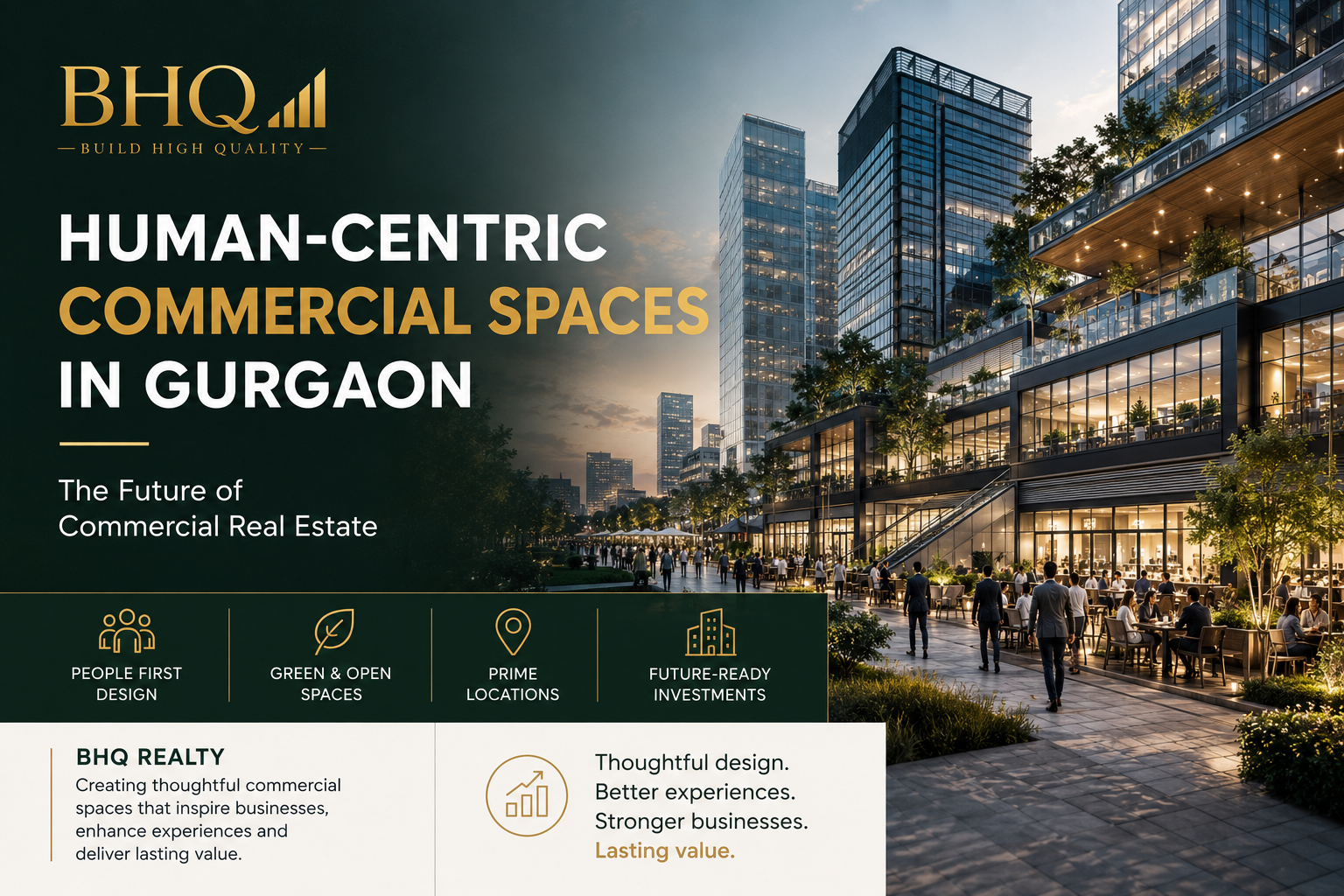
This shift is driving the rise of human-centric commercial spaces in Gurgaon developments designed around the people who work, shop, meet, dine, visit and do business within them.
As Gurgaon continues to evolve into one of India's leading business and lifestyle destinations, commercial development is no longer just about constructing buildings. It is about creating environments that are functional, comfortable, accessible and relevant to the way people live and work today.
For BHQ Realty, this changing landscape presents an important opportunity as the developer expands into commercial real estate with its first commercial project in Gurgaon.
What Is Human-Centric Commercial Design?
Human-centric design means putting people at the centre of the planning process.
Instead of asking only how much can be built on a site, developers increasingly need to consider how the finished environment will actually be used.
How will customers enter and move through the development?
How easily can businesses welcome their clients?
Can employees work comfortably?
Are common areas inviting?
Is the development easy to navigate?
Does the overall environment encourage people to spend more time there?
These considerations can influence everything from architecture and circulation to natural light, landscaping, accessibility, amenities and shared spaces.
The objective is simple:
Create commercial environments that work for people as well as businesses.
Why Gurgaon Is Ready for a New Approach to Commercial Real Estate
Gurgaon has transformed from a corporate satellite city into a major business, residential and lifestyle destination.
The city is home to multinational companies, startups, entrepreneurs, retail destinations, hospitality businesses and a growing professional population. At the same time, continued infrastructure development and expansion across emerging micro-markets are creating new commercial opportunities.
BHQ Realty itself highlights Gurgaon as a core market, with an understanding of the city's major sectors, pricing patterns, inventory and evolving buyer requirements.
As the city's commercial ecosystem becomes more sophisticated, businesses and investors are likely to place greater importance on the quality of the destination not simply its address.
This is where human-centric commercial development can make a difference.
1. Designing Around the Customer Journey
A successful commercial property begins long before a customer reaches a shop, office or business.
The experience starts with arrival.
Parking, entrances, pedestrian movement, signage, visibility, accessibility and internal circulation all contribute to the customer's perception of a property.
A well-planned commercial development should make this journey intuitive.
People should be able to understand where to go, move comfortably through the property and access the businesses they are looking for without unnecessary friction.
For retail and customer-facing businesses, this can be particularly important.
A thoughtfully designed environment can create a stronger connection between the customer and the brand operating within the space.
2. Creating Better Work Environments
The modern workplace has changed significantly.
Businesses today increasingly recognise that employees need more than a desk and four walls. Collaboration areas, informal meeting spaces, comfortable common areas, natural light and flexible environments can all contribute to a better workplace experience.
This does not mean that every commercial property needs to follow one particular design formula.
Instead, the focus should be on flexibility.
Commercial spaces should be capable of supporting different businesses, different working styles and changing requirements over time.
This approach can make a development more adaptable in a market where workplace expectations continue to evolve.
3. Natural Light and Open Spaces Matter
Some of the most important aspects of human-centric design are surprisingly simple.
Natural light, ventilation, landscaping and open areas can significantly influence how people experience a commercial environment.
A commercial development that balances built spaces with thoughtfully planned open areas can feel more welcoming and less congested.
Landscaped zones can also provide places for people to pause, meet or take a break.
In this sense, open space is not simply an architectural feature.
It becomes part of the overall experience of the destination.
4. Convenience Should Be Designed In
Good commercial design removes unnecessary friction.
Convenient access, logical circulation, visible entrances, well-planned parking, clear wayfinding and accessible common areas can all contribute to a smoother experience.
For businesses, convenience can influence customer satisfaction.
For visitors, it can influence whether they choose to return.
For investors, it can contribute to the long-term usability and appeal of the commercial asset.
This is why thoughtful commercial development needs to consider the entire user journey rather than focusing exclusively on individual units.
5. Commercial Spaces Should Encourage Interaction
The most successful commercial destinations often become more than collections of individual businesses.
They become places where people meet.
A café can become a meeting point. A retail environment can become a social destination. A well-designed common area can encourage informal interactions.
Human-centric commercial design recognises these behaviours and creates opportunities for them.
The result is a commercial environment that feels active and connected rather than purely transactional.
6. Design Can Influence Long-Term Commercial Value
Real estate is a long-term asset.
A commercial development therefore needs to remain relevant beyond its launch period.
Design plays an important role in this.
When a property is created around genuine user requirements, it has greater potential to remain functional as businesses, customers and workplace patterns evolve.
This is particularly important in Gurgaon, where new commercial developments continue to enter the market and businesses have more options when choosing where to establish themselves.
A strong location may attract attention.
But a strong experience can create lasting preference.
The Future of Commercial Projects in Gurgaon
The future of commercial real estate in Gurgaon is likely to be increasingly experience-driven.
Developers will need to think beyond conventional specifications and consider how their projects interact with the people who use them every day.
This could mean:
Better pedestrian movement
More intuitive layouts
Comfortable common spaces
Greater integration of greenery and open areas
Flexible commercial environments
Better accessibility
Improved customer journeys
More thoughtful workplace environments
Stronger connections between retail, work and lifestyle
The emphasis is shifting from simply asking "How much space are we building?" to asking "What kind of destination are we creating?"
BHQ Realty's Entry Into Commercial Development
BHQ Realty has established its presence in Gurgaon through a development approach centred on market understanding, transparency and customer-focused real estate solutions.
The company's website currently highlights its capabilities across residential development, builder floors, commercial property consulting and investor deal structuring.
Its move toward developing its first commercial project in Gurgaon represents an important next step.
Rather than viewing commercial real estate purely as a collection of units, the opportunity is to think about the larger ecosystem businesses, customers, employees, visitors and investors.
That perspective aligns naturally with the broader movement toward human-centric commercial development.
The next generation of commercial spaces will need to be more responsive to how people actually use them.
Why Human-Centric Commercial Real Estate Matters to Investors
For investors evaluating commercial property in Gurgaon, the conversation is increasingly about more than immediate returns.
Location, connectivity, demand and commercial viability remain fundamental. But the quality of the development itself can also influence its ability to remain attractive over time.
A well-designed commercial destination can potentially benefit from:
Better usability Spaces designed around real user requirements can be easier and more comfortable to use.
Stronger customer experience Convenient and engaging environments can help businesses create better interactions with their customers.
Adaptability Flexible spaces can respond more effectively to changing business requirements.
Long-term relevance Thoughtful planning can help a development remain competitive as expectations change.
For this reason, human-centric design should not be viewed simply as an architectural trend.
It can be part of a broader strategy for creating commercially relevant real estate.
Building Commercial Spaces for the People Who Bring Them to Life
A commercial development ultimately becomes successful because people use it.
Businesses bring their teams.
Customers bring their spending and engagement.
Employees bring productivity and ideas.
Visitors bring activity.
Investors bring capital and long-term confidence.
Every one of these groups experiences a property differently.
The challenge for modern developers is to bring these experiences together within one cohesive environment.
That is the essence of human-centric commercial design.
Gurgaon’s Commercial Future Is About More Than Buildings
Gurgaon's next generation of commercial developments will compete not only on location and specifications but also on experience.
The commercial spaces that understand people how they move, work, shop, meet and interact can create destinations that feel more relevant to modern urban life.
For BHQ Realty, its first commercial project in Gurgaon comes at an interesting moment in the city's evolution.
As the developer expands its presence and enters a new segment, the opportunity is to contribute to a more thoughtful approach to commercial real estate one where design, functionality and human experience work together.
Because the future of commercial real estate is not simply about building more spaces.
It is about building better places for people, businesses and communities.
And in a rapidly evolving market like Gurgaon, that distinction could define the commercial destinations of tomorrow.