In real estate, one principle has remained relevant for generations:
Location matters.
But when it comes to commercial real estate, location means much more than simply having a Gurgaon address.
A commercially valuable location is created by a combination of connectivity, people, businesses, visibility, infrastructure, demand and future development.
Two properties may be located in the same city and even within the same sector yet have very different commercial potential.
One may be surrounded by established offices and residential communities, have excellent road access and strong visibility.
Another may have limited accessibility, weaker surrounding development and significant competing supply.
This is why investors evaluating commercial property in Gurgaon need to look beyond the brochure and understand the fundamentals of the location.
For a growing market like Gurgaon, where infrastructure, residential development and business districts continue to evolve, understanding these factors can help buyers make more informed decisions.
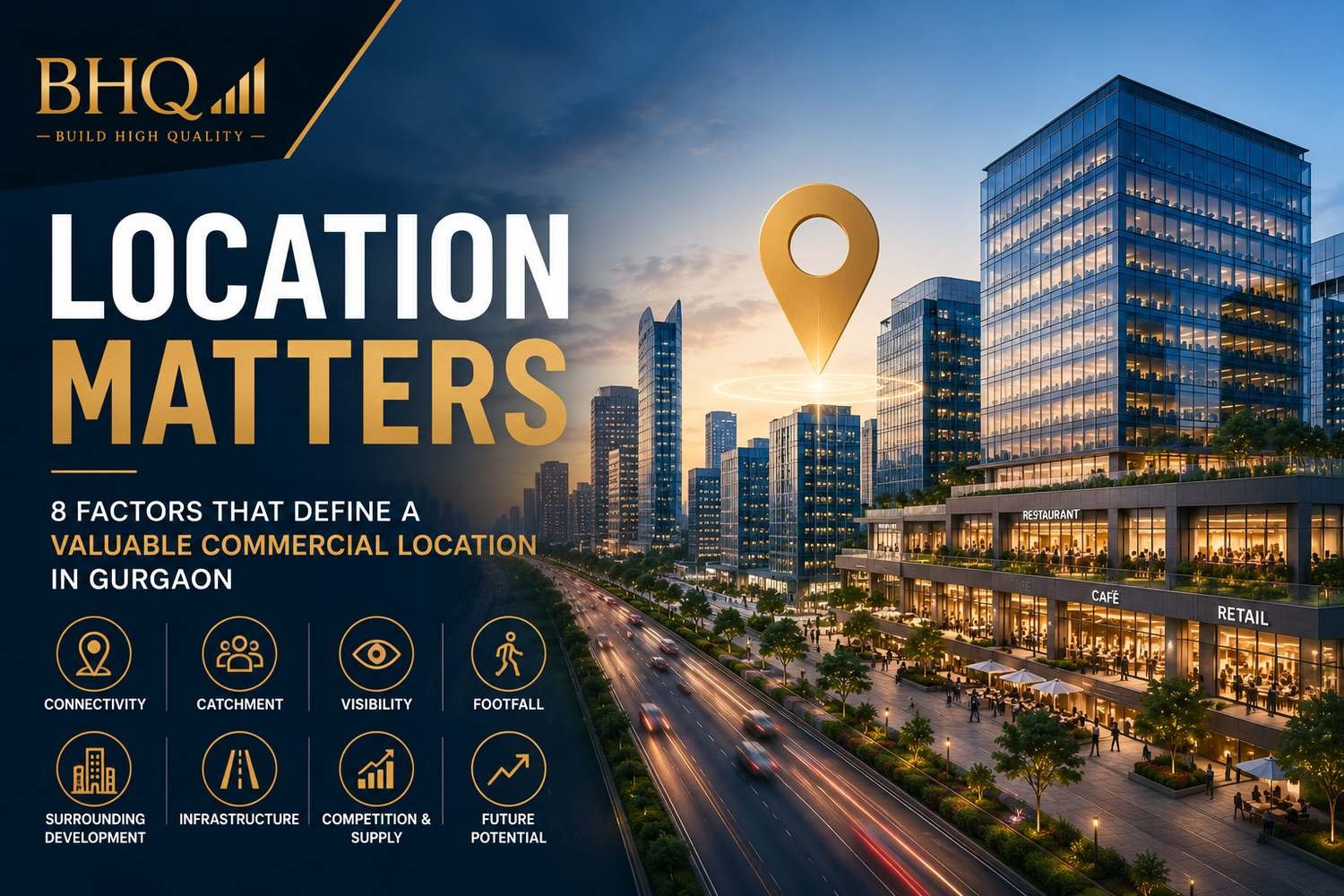
Here are eight important factors that can influence the value and commercial relevance of a location in Gurgaon.
Connectivity: Can People Reach the Property Easily?
The first question to ask about any commercial property is simple:
How easy is it to reach?
- A commercial property may have an attractive design and strong specifications, but accessibility remains fundamental.
- Businesses need employees to reach the workplace.
- Customers need convenient access to shops and restaurants.
- Clients need to find offices easily.
- Suppliers and service providers need reliable access.
This makes connectivity one of the most important factors when evaluating a commercial property location in Gurgaon.
Look at:
- Main roads
- Approach roads
- Expressways
- Internal roads
- Public transportation
- Metro connectivity
- Entry and exit points
- Traffic conditions
- Pedestrian accessibility
Gurgaon's major corridors including NH-48, Dwarka Expressway, Southern Peripheral Road, Golf Course Road, Golf Course Extension Road and Sohna Road are influencing the city's evolving commercial geography.
However, being "near" a major road is not enough.
The actual approach to the property matters.
A project five minutes from an expressway with poor access can have a very different user experience from a project with direct and convenient connectivity.
Catchment Area: Who Lives and Works Around the Property?
A commercial property needs people.
Retail needs customers.
Offices need employees.
Restaurants need diners.
Healthcare businesses need patients.
Professional services need clients.
Therefore, understanding the catchment area is critical.
A catchment area is broadly the geographic region from which a commercial property can attract its users.
When evaluating a location, consider:
- Existing residential population
- Upcoming housing projects
- Office population
- Nearby business districts
- Schools and institutions
- Hospitals
- Hotels
- Retail destinations
- Lifestyle developments
For example, a neighbourhood retail property may depend heavily on nearby residents, while a corporate office location may depend more on access to a large employment pool.
The ideal catchment therefore depends on the type of commercial property.
Visibility: Can Customers See the Property?
Visibility is particularly important for retail and customer-facing businesses.
A shop, showroom, restaurant or café benefits from being easy to identify.
Consider a simple example.
Two retail units have similar sizes and prices.
One is located prominently along a high-visibility frontage.
The other is hidden behind internal circulation.
Even if both have the same address, they may offer very different commercial experiences.
Important visibility factors include:
- Road frontage
- Signage opportunities
- Building orientation
- Entrance visibility
- Corner positioning
- Pedestrian visibility
- Vehicle visibility
For retail, visibility can directly influence how easily customers discover a business.
For offices, visibility may be less important than accessibility and professional environment.
Again, the property format matters.
Footfall: Is There Relevant Customer Movement?
Footfall is one of the most commonly discussed terms in commercial real estate.
But investors should be careful.
High footfall does not automatically mean high commercial value.
What matters is relevant footfall.
A location may have thousands of people passing through every day, but if they are not the target customers of the businesses operating there, the benefit may be limited.
Instead, ask:
- Who is visiting?
- Why are they visiting?
- How frequently do they visit?
- What do they spend money on?
- Does their profile match the businesses planned for the property?
For example:
- A premium restaurant may benefit from an affluent customer base.
- A neighbourhood grocery store may depend on local residents.
- A professional office may depend more on planned client visits than spontaneous footfall.
Understanding the quality of movement is therefore more useful than simply counting people.
Surrounding Residential and Commercial Development
A commercial property does not exist in isolation.
Its surroundings matter.
A location surrounded by established homes, offices and supporting services can have a very different commercial environment from a location surrounded by undeveloped land.
This is why investors should study the development pipeline.
Look at:
Residential projects
Who will live nearby?
Office developments
Where will employees come from?
Retail projects
What competition will businesses face?
Hospitality
Are hotels and business facilities developing nearby?
Social infrastructure
Are schools, hospitals and other facilities expanding?
The relationship between residential and commercial growth is particularly important.
A growing residential catchment can create demand for:
- Restaurants
- Cafés
- Fitness centres
- Healthcare
- Salons
- Convenience retail
- Professional services
This creates opportunities for neighbourhood commercial destinations.
Infrastructure Can Change a Location's Commercial Relevance
Infrastructure is one of the biggest forces shaping Gurgaon.
Road improvements, expressways, metro connectivity and other urban infrastructure can influence how accessible different areas become.
But there is an important distinction:
Existing infrastructure
Something people can use today.
Under-construction infrastructure
Something currently being developed.
Proposed infrastructure
Something planned but not yet operational.
Investors should treat these differently.
A proposed project may eventually improve accessibility, but there can be uncertainty around timing, execution and final outcomes.
Therefore, never base a commercial property decision entirely on a future infrastructure promise.
Instead, evaluate:
- What exists today?
- What is officially under development?
- How directly does it benefit this property?
- What other factors support demand?
This creates a more balanced view of location potential.
Competition and Future Supply
A location can have strong demand and still face challenges if too much competing commercial supply enters the market.
This is why investors should ask:
- How many similar projects are already operating nearby?
- How many are under construction?
- How many are planned?
- Are they targeting the same customers or tenants?
For example, if five new retail developments are planned within the same catchment, future competition could influence occupancy and rental dynamics.
Similarly, an office market with significant upcoming supply may behave differently from one where demand is growing faster than new inventory.
This does not mean new supply is necessarily negative.
Healthy competition can create stronger commercial ecosystems.
But investors should understand the balance between demand and supply.
8. Future Development Potential
A good commercial location should be evaluated not only for what exists today, but also for how the surrounding area could evolve.
This does not mean predicting guaranteed appreciation.
Real estate outcomes are never guaranteed.
Instead, investors should study the broader development trajectory.
Questions to consider:
- Is the population growing?
- Are businesses expanding?
- Is infrastructure improving?
- Are new residential communities being developed?
- Are new offices coming?
- Is the local retail ecosystem expanding?
- Is the government investing in urban infrastructure?
- Is the area becoming better connected?
The answers can provide useful context for evaluating the long-term relevance of a commercial location.
Gurgaon Is a Market of Multiple Micro-Markets
One of the most important things to understand about Gurgaon is that the city cannot be treated as one uniform real estate market.
Different corridors and sectors have different characteristics.
Some are primarily corporate.
Some are residential.
Some are emerging.
Some are lifestyle-oriented.
Some combine offices and retail.
Some are driven by infrastructure development.
Therefore, the phrase "commercial property in Gurgaon" covers a very diverse range of opportunities.
Investors should analyse the micro-market, not just the city.
Location for Office vs Location for Retail
The ideal commercial location depends heavily on the property's intended use.
For Office Property
Prioritise:
- Employee accessibility
- Business ecosystem
- Public transportation
- Parking
- Building quality
- Connectivity
- Nearby food and services
For Retail Property
Prioritise:
- Visibility
- Relevant footfall
- Customer catchment
- Frontage
- Accessibility
- Parking
- Complementary businesses
For Restaurants and F&B
Consider:
- Evening activity
- Customer demographics
- Visibility
- Parking
- Delivery access
- Surrounding offices and residences
For Neighbourhood Commercial
Consider:
- Residential population
- Daily-use demand
- Accessibility
- Local competition
- Convenience
There is no single definition of a "good location."
There is only a good location for a particular commercial purpose.
Why Parking Still Matters
Parking is sometimes treated as a secondary consideration.
For commercial properties, it can be critical.
Imagine a customer wanting to visit a restaurant but spending fifteen minutes searching for parking.
Or a client arriving at an office and struggling to find a convenient parking space.
These small inconveniences can influence the overall user experience.
Investors should therefore examine:
- Parking capacity
- Visitor parking
- Basement parking
- Entry and exit
- Parking management
- Peak-hour capacity
The actual requirements will depend on the project's size and commercial format.
The Role of the Developer
Location is important.
But the developer still matters.
A good location cannot compensate for poor project execution.
Before investing, research:
- Developer track record
- Previous projects
- Construction quality
- Delivery history
- Transparency
- Project approvals
- Maintenance strategy
- Customer experience
A commercial development is a long-term asset.
Its management and maintenance can influence how the property performs over time.
Don't Evaluate Location Through Price Alone
One common mistake is assuming:
Lower price = better opportunity.
That is not necessarily true.
A lower-priced commercial property may have:
- Lower demand
- Poor accessibility
- Weak visibility
- High competing supply
- Limited surrounding development
A higher-priced property may command a premium because of:
- Better location
- Stronger catchment
- Better accessibility
- Superior project quality
- Greater visibility
- Established commercial ecosystem
Price should therefore be evaluated in relation to fundamentals.
The question should be:
What am I getting for the price?
A Practical Location Checklist
Before buying a commercial property in Gurgaon, consider these questions:
Location
- Is the property easily accessible?
Connectivity
- Are major roads and public transport convenient?
Catchment
- Who lives and works nearby?
Visibility
- Can customers easily find the property?
Footfall
- Is the footfall relevant to the intended business?
Development
- What is being built around the property?
Competition
- How much competing supply exists?
Infrastructure
- What infrastructure is operational or officially under development?
Parking
- Is parking sufficient for the intended use?
Developer
- Is the developer credible and transparent?
Future
- Can the location remain commercially relevant as Gurgaon evolves?
If several of these questions remain unanswered, more research may be necessary before making a purchase decision.
BHQ Realty's Approach to Commercial Locations
BHQ Realty's Gurgaon-focused real estate approach includes market understanding, property shortlisting, site visits, transparent guidance and coordination through the buying process. Its current capabilities include private developments, builder floors, commercial property consulting and investor deal structuring. BHQ Realty
As BHQ Realty prepares to bring its first commercial project in Gurgaon, understanding location fundamentals becomes an important part of the development process.
The goal is not simply to identify a site.
It is to understand the relationship between:
People
Businesses
Infrastructure
Accessibility
Demand
Design
Future development
That is what can turn a location into a commercially meaningful destination.
The Future of Commercial Locations in Gurgaon
Gurgaon's commercial landscape will continue to evolve.
New infrastructure will influence movement.
Residential communities will create new catchments.
Businesses will establish new workplaces.
Retail and lifestyle destinations will follow changing consumer behaviour.
As this happens, the definition of a valuable commercial location will also evolve.
The strongest locations may increasingly be those where multiple factors converge:
Strong connectivity + growing catchment + business activity + quality infrastructure + relevant demand.
For investors, identifying these intersections can be more valuable than simply following the latest market trend.
Final Thoughts
A commercial property's address is only the starting point.
Its real commercial potential comes from everything around it.
The people who live nearby.
The businesses that operate nearby.
The roads that connect it.
The infrastructure that supports it.
The customers who visit it.
The visibility it receives.
The competition it faces.
And the development taking place around it.
This is why choosing the right commercial property location in Gurgaon requires more than looking at a map.
It requires understanding the entire ecosystem.
For buyers and investors, the goal should be to make decisions based on evidence, demand and fundamentals, rather than assumptions or promotional claims.
And for developers like BHQ Realty, the opportunity is to create commercial destinations where location, design, connectivity and real-world demand come together.
Because a great commercial property is not simply located somewhere.
It belongs somewhere.
Frequently Asked Questions
What makes a commercial property location valuable in Gurgaon?
Connectivity, catchment, visibility, relevant footfall, surrounding development, infrastructure, competition and future growth potential are among the key factors.
Which is more important for commercial property location or price?
Both matter, but price should be evaluated in relation to the fundamentals of the location and property. A lower price does not automatically mean better commercial value.
How do I evaluate a commercial location in Gurgaon?
Study the micro-market, connectivity, surrounding population, businesses, infrastructure, competition, parking, visibility and future development. A physical site visit is also highly recommended.
Is high footfall always good for retail property?
Not necessarily. The quality and relevance of footfall are often more important than the absolute number of visitors.
Should future infrastructure be considered when buying commercial property?
Yes, but investors should distinguish between operational, under-construction and proposed infrastructure and avoid treating proposed projects as guaranteed benefits.
What is BHQ Realty?
BHQ Realty is a Gurgaon-focused real estate company involved in development and commercial property services, including private developments, builder floors, commercial property consulting and investor deal structuring. BHQ Realty website