Gurgaon has undergone a remarkable transformation.
What was once largely considered a satellite city of Delhi has developed into one of India's most important corporate and commercial destinations.
Today, the city is home to multinational companies, Indian corporations, technology businesses, financial institutions, consulting firms, startups, Global Capability Centres and a growing ecosystem of retail, hospitality and lifestyle businesses.
This transformation has had a direct impact on real estate.
As companies establish offices, employees move into nearby residential communities. As residential populations grow, restaurants, retailers, healthcare providers, fitness centres and other businesses follow.
This creates a powerful relationship:
Businesses create employment → employment creates residential demand → residents create consumer demand → consumer demand creates commercial opportunities.
That interconnected ecosystem is one of the reasons commercial real estate in Gurgaon continues to attract attention.
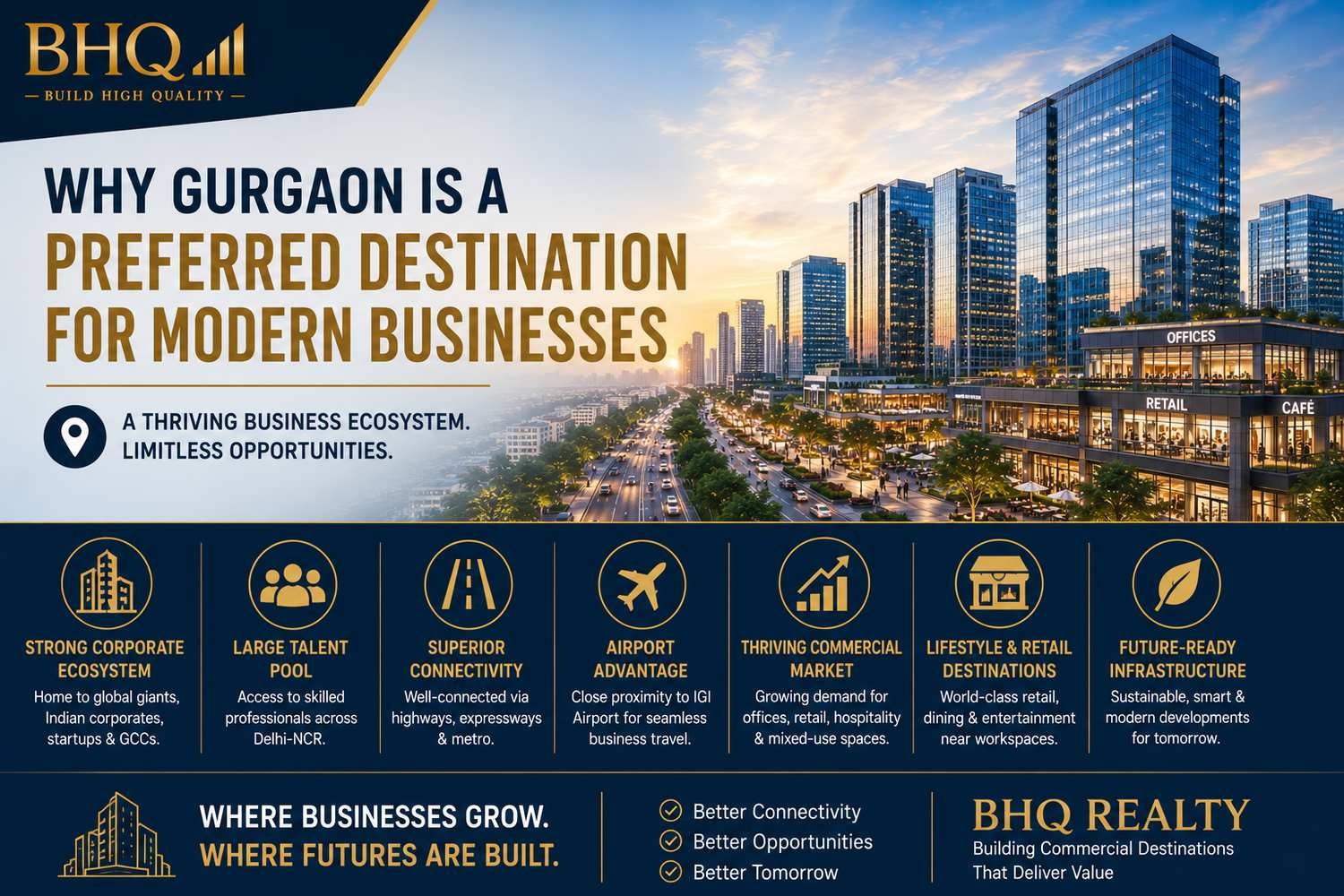
But what makes Gurgaon particularly attractive to modern businesses?
1. A Strong Corporate Ecosystem
One of Gurgaon's biggest advantages is the concentration of businesses already operating in the city.
The presence of established corporations creates an ecosystem rather than an isolated business district.
Companies benefit from being close to:
- Clients
- Vendors
- Professional services
- Financial institutions
- Technology providers
- Recruitment firms
- Hospitality
- Restaurants
- Business centres
This creates what economists often call agglomeration benefits—the advantages businesses receive when they operate close to other businesses and supporting services.
For commercial real estate, this is significant.
A strong business ecosystem can create recurring demand for:
- Offices
- Meeting spaces
- Restaurants
- Cafés
- Hotels
- Retail
- Professional services
2. Access to a Large Talent Pool
Modern businesses are increasingly dependent on talent.
A company's office location can influence how easily employees can commute to work.
Gurgaon's proximity to Delhi and its wider NCR connectivity give businesses access to a large employment catchment.
This is particularly important for sectors that require:
- Technology professionals
- Finance specialists
- Consultants
- Engineers
- Marketing professionals
- Management professionals
- Customer-service teams
For companies establishing large offices or Global Capability Centres, access to skilled employees is a major consideration.
This also creates demand for commercial locations that are convenient for employees—not just executives.
3. Connectivity Is a Major Business Advantage
3. Connectivity Is a Major Business Advantage
- Businesses need people to move.
- Employees commute.
- Clients visit.
- Partners travel.
- Goods and services need to be delivered.
- This makes connectivity a fundamental part of commercial real estate.
Gurgaon's network includes major corridors such as:
- NH-48
- Dwarka Expressway
- Southern Peripheral Road
- Golf Course Road
- Golf Course Extension Road
- Sohna Road
The city's connectivity to Delhi, the airport and other parts of the NCR has helped strengthen its position as a business destination.
However, connectivity should always be evaluated at the micro-market level.
Being located in Gurgaon does not automatically mean every commercial property has equally strong accessibility.
The exact approach roads, public transportation, parking and local traffic conditions still matter.
4. The Airport Advantage
For businesses with frequent travel requirements, proximity to an international airport can be valuable.
Gurgaon's location near Delhi's Indira Gandhi International Airport provides an advantage for businesses whose employees and clients travel frequently.
This can be particularly relevant for:
- Multinational companies
- Consulting firms
- Financial services
- Hospitality businesses
- International businesses
- Corporate headquarters
Easy airport access can also influence where companies choose to locate offices, particularly when senior executives and international visitors frequently travel.
5. Gurgaon Has Developed Beyond Traditional Office Space
The city's commercial ecosystem is no longer limited to conventional office buildings.
Modern businesses now use a wide range of workplace formats.
These include:
Conventional offices
Long-term dedicated corporate spaces.
Managed offices
Professionally operated workplaces.
Flexible workspaces
Coworking and adaptable office environments.
Business centres
Serviced spaces designed for companies and professionals.
Mixed-use developments
Offices combined with retail, dining and lifestyle facilities.
This variety gives businesses greater flexibility.
A startup may need a small flexible office.
A growing company may require a managed floor.
A multinational may require a large corporate campus.
The commercial market can therefore serve businesses at different stages of growth.
6. Global Capability Centres Are Changing the Office Market
Global Capability Centres have become an important part of India's corporate real estate story.
GCCs are increasingly responsible for activities that go beyond traditional back-office functions.
Depending on the organisation, they can include:
- Technology
- Research
- Engineering
- Analytics
- Finance
- Cybersecurity
- Product development
- Business operations
These organisations often require sophisticated office environments.
They may look for:
- Large floor plates
- High-quality infrastructure
- Strong connectivity
- Employee amenities
- Reliable technology
- Sustainability credentials
- Premium workplace environments
For Gurgaon, the expansion of such businesses creates another layer of demand for quality commercial real estate.
7. Residential and Commercial Growth Reinforce Each Other
One of Gurgaon's strongest characteristics is the close relationship between its residential and commercial development.
- Consider the cycle:
- A company opens an office.
- Employees need homes.
- Residential communities grow.
- Residents need services.
- Retail and restaurants open.
- More businesses are attracted.
- The commercial ecosystem becomes stronger.
- This cycle can be seen across multiple parts of Gurgaon.
It is one reason developers need to think about commercial projects as part of a broader urban ecosystem rather than isolated properties.
8. Businesses Want More Than Four Walls
The traditional office was relatively simple:
Desks + cabins + meeting rooms.
Modern workplaces are becoming more sophisticated.
Employees may now expect:
- Cafés
- Collaboration areas
- Wellness spaces
- Outdoor areas
- Informal meeting zones
- Fitness facilities
- Technology-enabled workspaces
- Better natural light
- Comfortable common areas
Companies are increasingly conscious of employee experience.
As a result, commercial developers have an opportunity to create spaces that support productivity and wellbeing.
This is where human-centric commercial design becomes important.
9. Retail Benefits From the Corporate Population
Gurgaon's large office population creates a significant consumer base.
Employees need services during the working day.
They may visit:
- Cafés
- Restaurants
- Pharmacies
- Salons
- Convenience stores
- Fitness centres
- Banks
- Professional services
This creates opportunities for commercial projects located near office clusters.
The same principle works in reverse.
A strong retail and lifestyle ecosystem can make an office location more attractive to employees.
This creates a mutually supportive relationship between office and retail.
10. Hospitality Is Part of the Business Ecosystem
A major business destination also requires hospitality.
Corporate visitors may need:
- Hotels
- Business lounges
- Restaurants
- Meeting facilities
- Event venues
Gurgaon's hospitality sector has developed alongside its corporate market.
This makes the city more convenient for businesses dealing with clients and employees from outside the NCR.
Hospitality also contributes to commercial activity beyond traditional office hours.
11. Gurgaon Is Becoming More Experience-Led
The future commercial environment is increasingly about experience.
A business district can no longer be evaluated only by office space.
Companies and employees also consider:
- What restaurants are nearby?
- Is there retail?
- Is there parking?
- Is public transportation accessible?
- Are there places to meet?
- Is the environment attractive?
- Can employees take a break?
- Is the location convenient after office hours?
This is one reason mixed-use developments are becoming increasingly relevant.
Businesses want efficiency.
Employees want convenience.
Customers want experience.
Modern commercial development needs to consider all three.
12. Infrastructure Continues to Expand the Commercial Map
12. Infrastructure Continues to Expand the Commercial Map
One of the defining characteristics of Gurgaon is its continuously evolving infrastructure.
As new roads and transportation connections improve accessibility, previously emerging areas can become more practical for businesses and residents.
But infrastructure should be viewed carefully.
A commercial property should ideally have a strong current proposition rather than depending entirely on an infrastructure project that may be years away.
Investors should distinguish between:
Existing connectivity
Infrastructure under development
Proposed infrastructure
This distinction can help prevent overly optimistic assumptions.
13. Gurgaon Offers Multiple Commercial Micro-Markets
Another reason Gurgaon is attractive to businesses is the diversity of its commercial locations.
Different corridors offer different advantages.
Established Corporate Areas
These benefit from mature business ecosystems.
Premium Business Corridors
These can attract high-end offices and professional services.
Emerging Corridors
These can provide newer commercial environments and developing catchments.
Residential-Led Areas
These can support neighbourhood retail and services.
Mixed-Use Zones
These can combine offices, retail and lifestyle activity.
This means a business can choose a location based on its specific needs.
There is no single "best" commercial location for every company.
14. Startups and Growing Businesses Need Flexibility
Large corporations are not the only businesses driving commercial demand.
Gurgaon also has a significant ecosystem of smaller and growing companies.
For these businesses, flexibility can be more important than prestige.
They may prefer:
- Smaller office units
- Flexible leases
- Managed offices
- Shared facilities
- Lower initial fit-out costs
- Ability to expand later
This creates opportunities for commercial developments that offer multiple space formats.
A well-designed project can potentially serve businesses from early-stage companies to established enterprises.
15. The Future Office Will Be More Flexible
The workplace is changing.
Hybrid work has challenged the idea that every employee needs a permanent desk every day.
Companies are therefore reassessing their office requirements.
Future commercial spaces may increasingly include:
- Flexible floor plans
- Collaboration zones
- Meeting rooms
- Private offices
- Shared facilities
- Technology infrastructure
- Event spaces
This creates a new challenge for developers.
Commercial buildings need to remain adaptable.
A rigid layout may become less attractive as business requirements change.
16. Sustainability Is Becoming a Business Consideration
Sustainability is increasingly relevant to corporate occupiers.
Companies with global ESG policies may prefer buildings that support their environmental goals.
This can include:
- Energy-efficient systems
- Efficient water management
- Green building certifications
- Waste management
- EV infrastructure
- Natural lighting
- Efficient HVAC systems
- Sustainable landscaping
For developers, sustainability is increasingly becoming part of the overall commercial proposition.
It is no longer simply about adding a few green features.
It is about designing buildings that operate efficiently over the long term.
17. What Does This Mean for Commercial Property Investors?
The growth of Gurgaon's business ecosystem creates opportunities for commercial property—but investors need to analyse the fundamentals.
Before purchasing commercial property, ask:
Who is the likely tenant?
A property should have a clear user profile.
What businesses are nearby?
A strong ecosystem can support demand.
How accessible is the property?
Employees and customers need convenient access.
Is the catchment growing?
Residential and office growth can support future demand.
How much competing supply exists?
Competition matters.
Is the property future-ready?
Design, technology and flexibility can influence long-term relevance.
Who will manage the property?
Maintenance and management can influence user experience.
18. The Developer Matters
A good commercial location does not automatically create a successful project.
Execution matters.
When evaluating a commercial development, research:
- Developer track record
- Previous projects
- Construction quality
- Delivery history
- Transparency
- Project approvals
- Maintenance strategy
- Customer experience
The quality of the development can influence both businesses and customers.
This is particularly important for commercial properties because tenants often want to protect their brand image.
19. Gurgaon Is Becoming a Destination, Not Just a Location
This may be one of the biggest changes in Gurgaon's real estate story.
Earlier, businesses primarily asked:
"Where can we rent an office?"
Today, the question is increasingly:
"What kind of environment do we want our employees and clients to experience?"
- That changes the role of commercial real estate.
- The building becomes part of the company's identity.
- The surrounding retail becomes part of the employee experience.
- The connectivity becomes part of operational efficiency.
- The neighbourhood becomes part of the brand environment.
- Commercial property is therefore becoming increasingly integrated with business strategy.
What Could the Next Phase of Gurgaon Look Like?
The next phase of Gurgaon may increasingly combine:
- Corporate offices
- Residential communities
- Retail
- Hospitality
- Wellness
- Entertainment
- Technology
- Sustainable infrastructure
This creates a more complete urban ecosystem.
- For businesses, it offers convenience.
- For employees, it offers better lifestyle integration.
- For customers, it creates more destinations.
- For developers, it creates opportunities to build differentiated commercial projects.
BHQ Realty's Vision for Commercial Development
BHQ Realty is building its presence in Gurgaon through real estate development and commercial property services, including private developments, builder floors, commercial property consulting and investor deal structuring. BHQ Realty
As BHQ Realty prepares to bring its first commercial project in Gurgaon, the city's evolving business ecosystem provides an important foundation.
The opportunity is not simply to create commercial space.
It is to create an environment where:
- Businesses can grow.
- People can work comfortably.
- Customers can connect.
- Retailers can build businesses.
- Investors can evaluate long-term value.
That requires attention to location, design, connectivity, quality and user experience.
What Businesses Should Look for in a Gurgaon Commercial Property
For companies evaluating office or commercial space, a practical checklist can include:
- ✓ Connectivity
- ✓ Employee accessibility
- ✓ Parking
- ✓ Digital infrastructure
- ✓ Office flexibility
- ✓ Food and retail options
- ✓ Building quality
- ✓ Sustainability
- ✓ Security
- ✓ Maintenance
- ✓ Brand environment
- ✓ Expansion potential
A property that performs well across these factors can potentially provide a stronger workplace environment.
What Investors Should Watch
For commercial property investors, the checklist is slightly different:
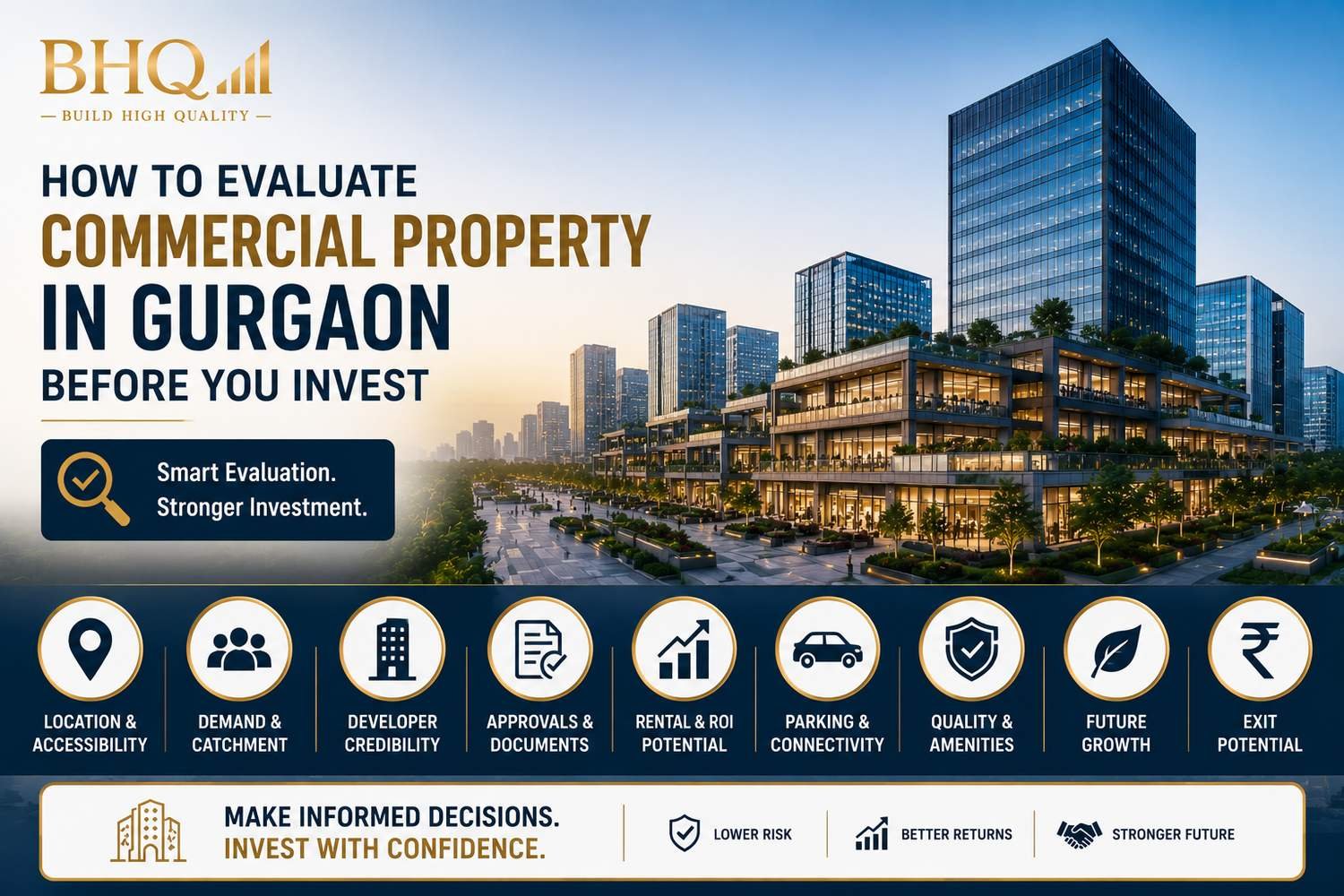
- ✓ Location
- ✓ Demand
- ✓ Tenant profile
- ✓ Rental market
- ✓ Vacancy risk
- ✓ Competing supply
- ✓ Developer track record
- ✓ Project approvals
- ✓ Total acquisition cost
- ✓ Maintenance costs
- ✓ Exit potential
The most important point is to avoid evaluating commercial property solely on a projected return.
The underlying demand needs to make sense.
Conclusion
Gurgaon's rise as a business destination has transformed its real estate market.
The city now offers far more than traditional office space.
It has developed an interconnected ecosystem of:
Businesses + Employees + Homes + Retail + Hospitality + Lifestyle.
That ecosystem continues to create opportunities for commercial real estate.
But the next phase will require a different approach.
Businesses will want flexibility.
Employees will want better experiences.
Customers will want convenience.
Investors will want stronger fundamentals.
And developers will need to create spaces that remain relevant as the market evolves.
For BHQ Realty, this creates an opportunity to participate in Gurgaon's next chapter of commercial growth with a focus on quality, thoughtful planning and real-world usability.
Because the future of commercial real estate isn't simply about finding a place to do business.
It's about creating places where businesses, people and communities can grow together.
Frequently Asked Questions
Why is Gurgaon attractive to businesses?
Gurgaon's corporate ecosystem, talent pool, connectivity, proximity to Delhi and the airport, commercial infrastructure and growing residential catchments make it an important business destination.
Is Gurgaon good for commercial real estate?
Gurgaon has a large and diversified commercial ecosystem, but individual properties should be evaluated based on location, demand, connectivity, supply, developer quality and tenant potential.
What types of businesses operate in Gurgaon?
The city has a diverse business base including multinational corporations, Indian companies, technology firms, financial services, consulting businesses, startups and Global Capability Centres.
Why are flexible offices becoming popular?
Flexible offices allow businesses to scale their space requirements, reduce upfront setup requirements and adapt more easily to changing workforce and workplace needs.
Why is mixed-use development important for Gurgaon?
Mixed-use developments can bring offices, retail, dining and lifestyle services together, creating convenient destinations for employees, customers and residents.
What should investors check before buying commercial property?
Investors should examine location, demand, tenant profile, connectivity, competing supply, developer track record, approvals, total costs and potential exit options.
What is BHQ Realty?
BHQ Realty is a Gurgaon-focused real estate company involved in development and commercial property services and is preparing to introduce its first commercial project in Gurgaon.