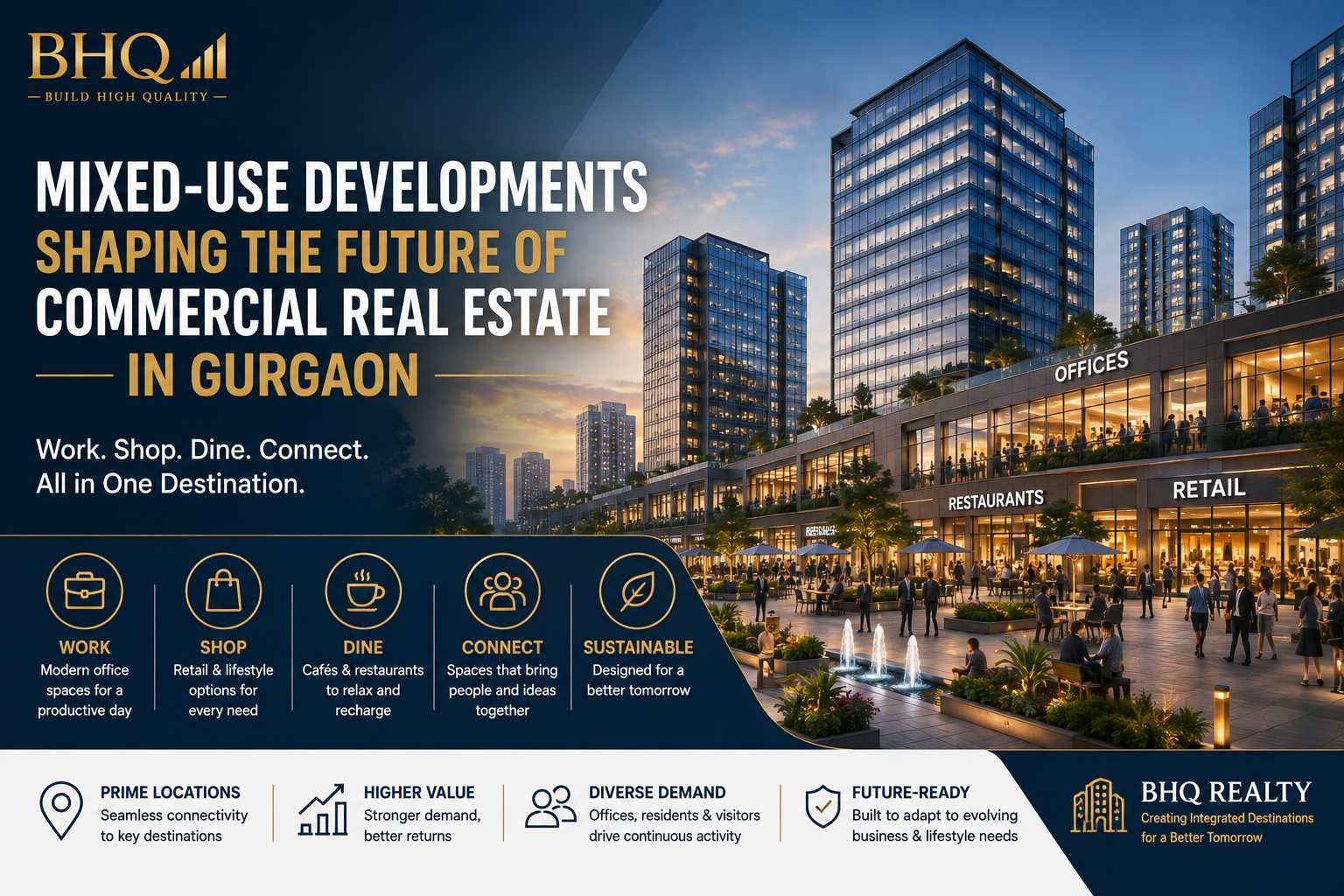
The way people use cities is changing.
Work, shopping, dining, entertainment and everyday services are no longer necessarily separate activities requiring separate destinations.
A professional may work in an office, meet a client over coffee, have lunch, visit a fitness centre and pick up groceries all within the same neighbourhood or commercial destination.
This changing lifestyle is contributing to the rise of mixed-use developments in Gurgaon.
Instead of creating isolated office buildings or standalone retail destinations, mixed-use developments bring different activities together within a connected environment.
For a city like Gurgaon, where business districts, residential communities and infrastructure corridors continue to expand, this approach has significant relevance.
The idea is simple:
Create places where people can work, shop, dine, meet and experience more within a well-planned environment.
For BHQ Realty, as it prepares to bring its first commercial project to Gurgaon, understanding this evolution is important to creating commercial spaces that remain relevant to businesses, customers and investors.
What Is a Mixed-Use Development?
A mixed-use development combines two or more different real estate uses within an integrated project or destination.
Depending on the project, this can include:
- Offices
- Retail
- Restaurants
- Cafés
- Entertainment
- Hospitality
- Wellness
- Professional services
- Residential spaces
- Public or landscaped areas
The objective is not simply to put different property types next to each other.
A successful mixed-use development should make these uses complementary.
For example:
- Offices create a daily working population.
- Restaurants serve employees and visitors.
- Retail provides convenience.
- Lifestyle businesses increase dwell time.
- Public spaces create opportunities for interaction.
The result is a more complete commercial ecosystem.
Why Is This Model Relevant to Gurgaon?
Gurgaon has developed into a city where business and lifestyle increasingly overlap.
The city has:
- Large corporate districts
- Expanding residential communities
- International businesses
- Startups
- Retail destinations
- Restaurants
- Hospitality
- Entertainment
- New infrastructure corridors
This creates an environment where mixed-use commercial destinations can serve multiple types of users.
An office worker may need a café during the day.
A nearby resident may visit a restaurant in the evening.
A customer may combine shopping with dining.
A professional may meet a client at a business lounge.
The same physical destination can therefore serve different users at different times.
That can create a more active and dynamic environment.
1. Convenience Is Becoming a Major Part of Real Estate
Modern consumers value convenience.
People increasingly want to accomplish multiple activities without spending excessive time travelling between destinations.
A well-planned mixed-use development can bring complementary services closer together.
Imagine a business district where employees can access:
Office → Café → Restaurant → Fitness → Pharmacy → Banking → Retail
without needing to travel to several different parts of the city.
That is more than an amenity.
It is a user-experience advantage.
As Gurgaon becomes denser and commuting patterns become more complex, convenience can become increasingly valuable.
2. Mixed-Use Developments Can Create Multiple Demand Drivers
One of the biggest advantages of an integrated commercial environment is that demand does not necessarily come from just one source.
A standalone office property may primarily depend on businesses.
A standalone retail project may depend heavily on consumers.
A mixed-use destination can potentially benefit from several groups:
- Employees
- Residents
- Customers
- Visitors
- Business owners
- Professionals
- Tourists or hotel guests, depending on the project
This diversity can create a broader commercial ecosystem.
However, diversification does not guarantee success.
Each component still needs to be appropriately planned and supported by genuine market demand.
3. Offices Can Support Retail
One of the strongest relationships within mixed-use development is the connection between offices and retail.
Consider a commercial destination with hundreds or thousands of employees.
Those employees create daily demand for:
- Coffee
- Breakfast
- Lunch
- Snacks
- Fitness
- Personal services
- Healthcare
- Convenience retail
This can provide a natural customer base for supporting businesses.
The office component therefore becomes an important driver for the retail environment.
This is one reason commercial planning should consider the entire ecosystem, rather than treating office and retail as completely separate categories.
4. Retail Can Improve the Office Experience
The relationship works in the other direction too.
Employees increasingly expect workplaces to provide more than desks and meeting rooms.
A nearby ecosystem of cafés, restaurants, shops and lifestyle services can make a workplace more convenient and attractive.
For companies, this can influence:
- Employee experience
- Client meetings
- Workplace convenience
- Business networking
- Informal collaboration
A commercial destination can therefore become part of the workplace experience itself.
5. Experience Is Becoming a Commercial Differentiator
Physical commercial spaces face increasing competition from digital alternatives.
People can:
- Shop online
- Order food
- Work remotely
- Book services digitally
- Attend virtual meetings
So why visit a physical commercial destination?
Because physical environments can offer experience.
People can meet.
They can socialise.
They can discover new businesses.
They can enjoy food.
They can attend events.
They can interact with brands.
They can simply spend time in a pleasant environment.
This is why the design of modern commercial destinations increasingly incorporates:
- Landscaping
- Open spaces
- Seating
- Cafés
- Dining
- Walkways
- Event areas
- Community spaces
6. Human-Centric Design Becomes Even More Important
Mixed-use development naturally connects with the concept of human-centric commercial design.
When multiple activities exist in one destination, planning becomes more complex.
People need to move between different areas.
Employees need efficient access.
Customers need intuitive navigation.
Retailers need visibility.
Restaurants need appropriate frontage.
Parking needs to work for different users.
Pedestrian movement needs to be considered.
This means design has to begin with people.
A good mixed-use project asks:
- How will people arrive?
- Where will they go?
- How will different activities interact?
- Where will people spend time?
- How can the experience remain comfortable during busy periods?
These questions can influence the long-term usability of a development.
7. Connectivity Becomes Even More Important
Mixed-use developments serve multiple user groups.
That makes accessibility particularly important.
The location needs to work for:
- Employees
- Customers
- Residents
- Visitors
- Delivery services
- Business owners
This is where Gurgaon's evolving infrastructure becomes relevant.
Major corridors such as:
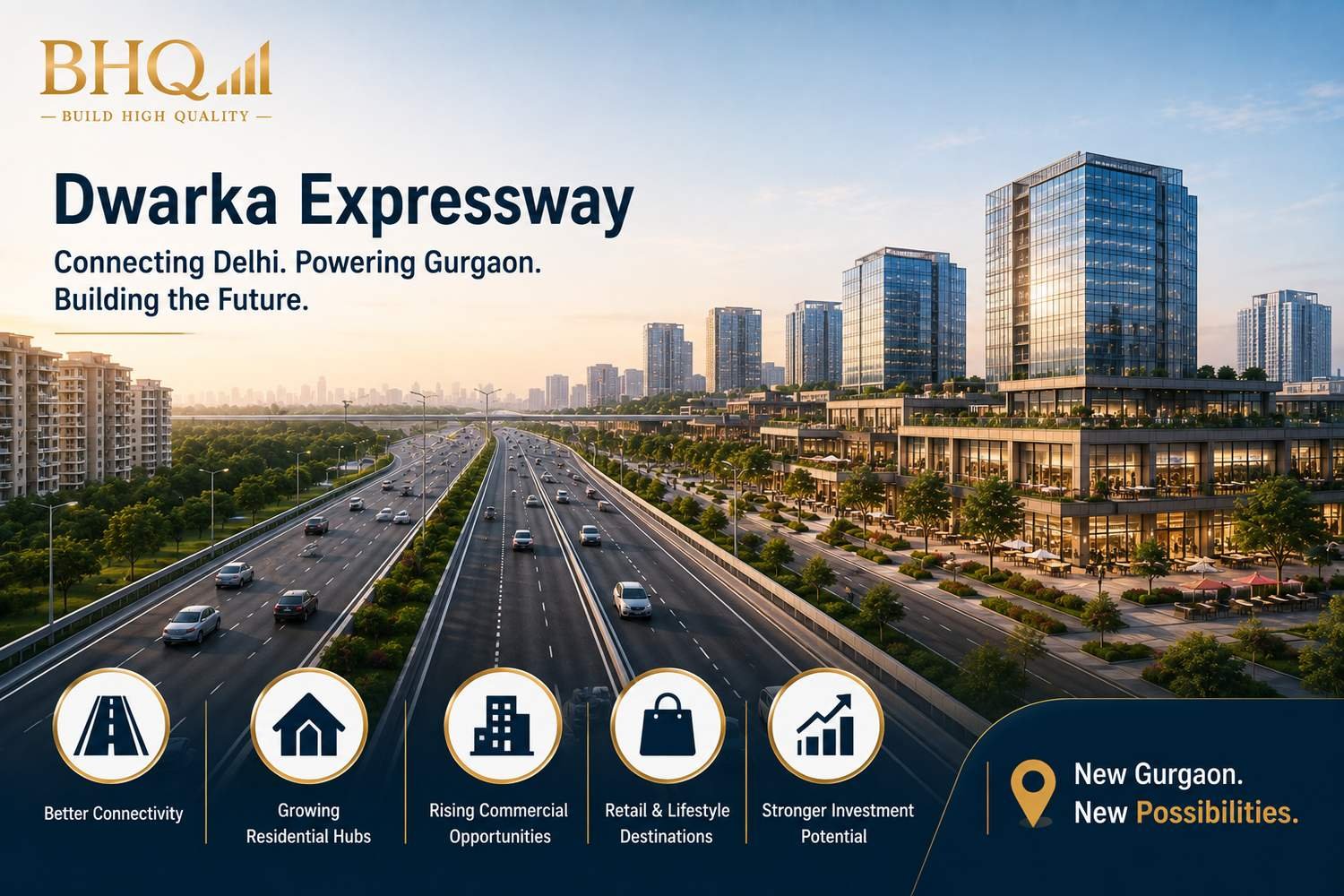
- Dwarka Expressway
- NH-48
- Southern Peripheral Road
- Golf Course Road
- Golf Course Extension Road
- Sohna Road
are influencing the way people move across the city.
But a commercially viable location needs more than a nearby highway.
Investors should examine:
Actual access + surrounding development + catchment + parking + public transportation + future infrastructure.
8. Mixed-Use Projects Can Increase Activity Throughout the Day
Another interesting characteristic of mixed-use destinations is the potential for activity across different time periods.
Morning
Employees arrive.
Cafés and breakfast businesses become active.
Afternoon
Offices operate.
Restaurants and retail businesses serve employees and customers.
Evening
Dining and lifestyle businesses become more active.
Weekend
Retail, entertainment and restaurants can attract families and local visitors.
This creates the possibility of a destination that remains active beyond traditional office hours.
The actual activity profile will, of course, depend on the project's location, tenant mix and surrounding catchment.
9. The Importance of Tenant Mix
A mixed-use development is only as strong as its ecosystem.
The businesses operating within the project need to complement each other.
For example:
A premium office environment may benefit from quality cafés, restaurants, convenience services and professional businesses.
A family-oriented destination may require restaurants, lifestyle retail and entertainment.
A neighbourhood commercial project may focus more on everyday services.
Therefore, tenant mix matters.
Too many similar businesses can create unnecessary competition.
Too little diversity can make the destination less attractive.
A thoughtful tenant strategy can help create a more balanced environment.
10. Parking and Movement Cannot Be an Afterthought
One of the biggest challenges in commercial development is movement.
A project may look attractive on paper but struggle if:
- Parking is inadequate
- Entry points are poorly planned
- Internal circulation is confusing
- Pedestrian movement is uncomfortable
- Deliveries interfere with customers
- Peak-hour congestion becomes excessive
Mixed-use developments have to account for different movement patterns.
Office users may arrive during the morning.
Retail customers may arrive throughout the day.
Restaurants may become busier in the evening.
Delivery vehicles may have different requirements.
Good planning needs to anticipate these patterns.
11. Sustainability Can Become Part of the Development Strategy
Mixed-use developments also provide opportunities to incorporate sustainability at a larger scale.
Potential elements include:
- Energy-efficient buildings
- Natural lighting
- Efficient water management
- Landscaping
- Waste management
- EV charging infrastructure
- Pedestrian-friendly design
- Efficient common areas
Sustainability should not simply be treated as a marketing feature.
The goal should be to create commercial environments that operate efficiently and remain comfortable and relevant over the long term.
12. What Does Mixed-Use Development Mean for Investors?
For someone evaluating commercial property in Gurgaon, mixed-use projects can provide an interesting proposition.
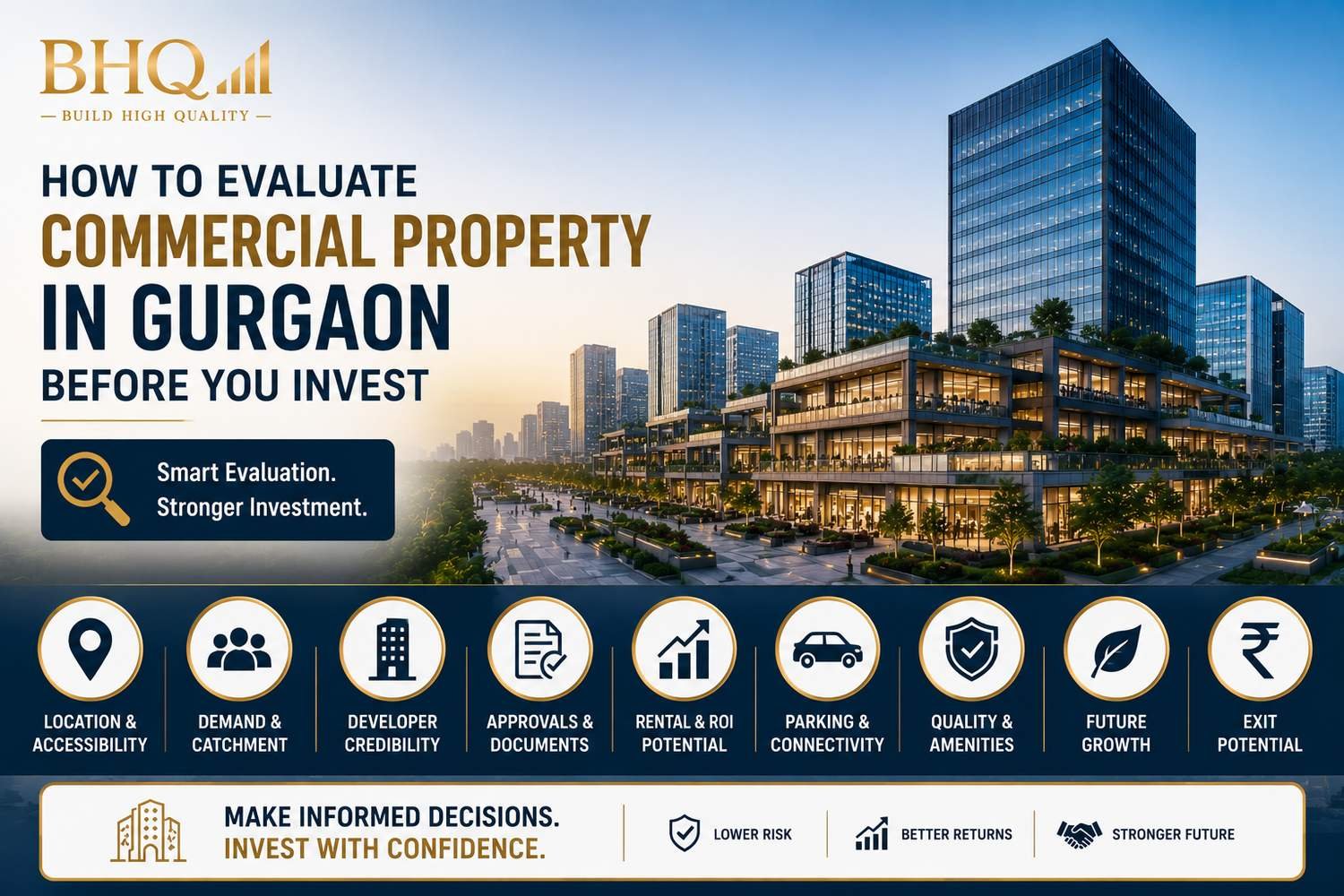
But investors should still conduct detailed due diligence.
Consider:
Location
Is the destination accessible to its intended users?
Catchment
Who lives and works around the project?
Tenant Demand
What businesses are likely to operate there?
Project Design
Are office, retail and lifestyle components integrated effectively?
Parking
Can the development handle peak demand?
Developer
Does the developer have the capability to execute and maintain the project?
Competition
What other commercial destinations are nearby?
Total Cost
What is the complete cost of ownership?
Long-Term Relevance
Can the destination remain commercially attractive as the surrounding market develops?
Mixed-Use Does Not Automatically Mean Better
It is important to maintain a balanced perspective.
Mixed-use development is not a guarantee of commercial success.
A project can have multiple components and still struggle if:
- The location lacks demand
- Accessibility is poor
- The tenant mix is weak
- The project is poorly managed
- Parking is inadequate
- Surrounding development is limited
- Supply significantly exceeds demand
The real value comes from integration and planning, not simply the number of uses.
Gurgaon Is Moving Toward More Integrated Commercial Destinations
As Gurgaon continues to mature, commercial real estate is becoming increasingly sophisticated.
The city is moving beyond isolated buildings toward destinations that combine multiple functions.
This reflects a broader urban trend:
- Work is changing.
- Retail is changing.
- Consumer behaviour is changing.
- Mobility is changing.
And real estate needs to respond.
The commercial destinations of the future are likely to be those that understand these changes and create environments around them.
BHQ Realty and the Next Generation of Commercial Development
BHQ Realty is building its presence in Gurgaon with a focus on real estate development, private developments, builder floors, commercial property consulting and investor deal structuring. Its Gurgaon-focused approach emphasises market understanding, transparent guidance and customer-focused real estate solutions. BHQ Realty
As the company prepares to introduce its first commercial project in Gurgaon, the evolution toward integrated commercial environments offers an important opportunity.
The objective is not simply to build commercial units.
It is to understand how businesses, customers and communities use space.
That means thinking about:
- Accessibility.
- Convenience.
- Experience.
- Business demand.
- Retail demand.
- Connectivity.
- Long-term usability.
These principles can help create commercial spaces that are designed not just for today's market, but for the way Gurgaon is likely to live and work tomorrow.
The Future of Commercial Real Estate Is About Destinations
The commercial property market is gradually moving beyond the idea of isolated assets.
A successful commercial destination can become part of people's daily routines.
It can be:
- A place to work.
- A place to meet.
- A place to shop.
- A place to dine.
- A place to connect.
- A place to spend time.
That is the potential of mixed-use development.
For Gurgaon, a city where business, residential growth, infrastructure and lifestyle increasingly overlap, this model is particularly relevant.
Conclusion
The rise of mixed-use developments in Gurgaon reflects a broader change in how people experience cities.
Commercial real estate is no longer only about offices, shops or individual buildings.
It is increasingly about creating connected environments where different activities support one another.
For businesses, that can mean greater convenience.
For customers, better experiences.
For developers, an opportunity to create more complete destinations.
And for investors, another commercial format to evaluate based on location, demand, planning and long-term fundamentals.
As Gurgaon continues to evolve, the most relevant commercial developments may not simply be the largest ones.
They may be the ones that understand how people want to live, work, shop and connect.
And for BHQ Realty, that understanding can become an important part of its vision for the next generation of commercial real estate in Gurgaon.
Frequently Asked Questions
What is a mixed-use development?
A mixed-use development combines two or more real estate uses, such as offices, retail, restaurants, hospitality, residential spaces or lifestyle facilities, within an integrated destination.
Why are mixed-use developments becoming popular in Gurgaon?
Gurgaon's growing business ecosystem, residential population, infrastructure and lifestyle demand create opportunities for commercial destinations that combine multiple uses and provide greater convenience.
Are mixed-use developments good for investors?
They can offer diversified commercial activity, but investors should evaluate each project individually based on location, demand, tenant mix, connectivity, supply, developer credibility and total costs.
What is the difference between mixed-use and traditional commercial development?
Traditional commercial developments may focus primarily on one use, such as offices or retail. Mixed-use developments integrate multiple uses to create a broader commercial ecosystem.
Why is tenant mix important?
A balanced tenant mix can help different businesses complement one another and create reasons for customers, employees and visitors to spend more time within the destination.
What is BHQ Realty's role in Gurgaon?
BHQ Realty is a Gurgaon-focused real estate company involved in development and commercial property services, and is expanding into commercial development with its first commercial project in Gurgaon.